Licenses
✍️ Akansha • 23 November 2026 • 15 min read
FSSAI Payment Deducted but FoSCoS Shows Pending Payment Verification?
Get Free Consultation
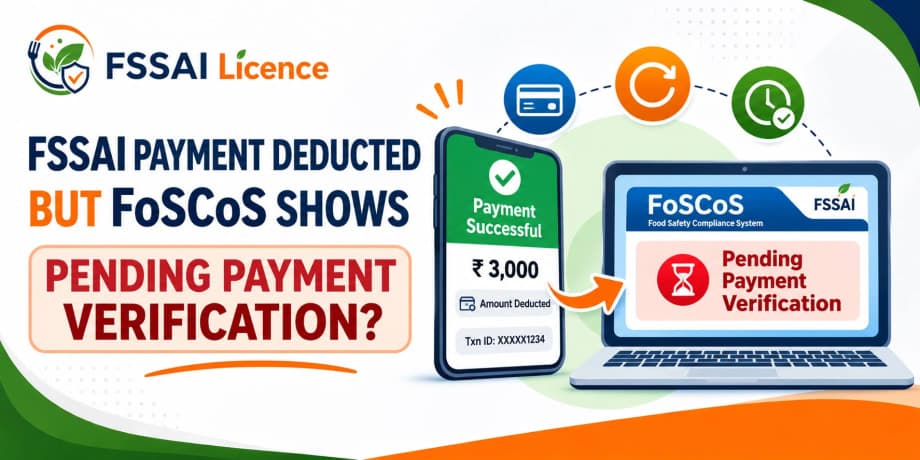
If money has left your account but FoSCoS shows pending payment verification, keep the transaction details and check the existing application before paying again. A bank debit alone does not establish whether the payment reached the relevant account or was matched to your application; your bank and FoSCoS support may need to trace different parts of the transaction.
Start with the Food Safety Compliance System, or FoSCoS, at foscos.fssai.gov.in. Use the application and payment records to identify what is actually pending, then contact the appropriate support channel if the status does not resolve. This guide explains what to prepare, how to follow up and what changes once the payment is recognised.
1. What FoSCoS pending payment verification means
Pending payment verification indicates that the payment outcome shown against an application has not yet been confirmed in the portal. The wording on your screen matters: a pending payment, a failed payment and an application awaiting review are different situations, even if each prevents you from seeing a completed licence.
A food licence is the regulatory permission relevant to a food business under the Food Safety and Standards framework. FoSCoS is the online system used for food business licensing and registration; a payment status is one part of an application record, not the licence itself.
1.1 Four separate stages
First, your bank or payment provider records the transaction. Second, the payment channel must report an outcome. Third, the portal must associate that outcome with the correct application. Finally, the application goes through the applicable regulatory process. A delay or discrepancy at one stage does not tell you what happened at every other stage.
For example, a debit may appear in a banking app while the final transaction outcome is still unclear. Equally, a payment could have been processed but not yet reflected against the application. These are possibilities to investigate, not conclusions that can be drawn from the debit message alone.
Keep the exact FoSCoS status rather than describing every problem as “payment failed.” Accurate wording helps the person tracing the transaction understand whether you are reporting an uncertain payment outcome, an application status problem or both.
2. Who should use this guide and what to check first
This guide is for an applicant or an authorised representative dealing with an existing FoSCoS payment attempt. It is relevant to a restaurant, manufacturer, trader, importer, exporter or other food business when money has been debited but the associated application does not show a settled payment outcome.
There should be an identifiable FoSCoS application or payment attempt to investigate. Without an application reference, support may need other details to locate the record.
The person following up should have access to the application details and be able to obtain a transaction record from the payer.
The issue should concern a payment outcome or its association with an application. A later regulatory query or licence decision is a separate matter.
2.1 Where the food licence category fits
Food businesses may need registration, a state licence or a central licence, depending on the applicable eligibility rules and their activities. A payment-tracing request does not by itself change the category selected in the application. If the category appears wrong, address that separately rather than assuming a corrected payment will fix it.
For a new filing, the registration application is associated with Form A and the licence application with Form B under the FSSAI framework. Those forms concern the underlying application; this payment problem does not automatically require a fresh Form A or Form B. The appropriate application category and current portal instructions should guide any new filing.
If you need help preparing an underlying application rather than tracing a payment already attempted, FSSAI Registration assistance is available from FSSAI Licence. Keep that work separate from the question of what happened to the existing payment.
3. Evidence to prepare for payment tracing
Prepare a concise record before contacting anyone. The objective is to let the bank identify the debit and let portal support locate the application, without sending unnecessary banking information.
Application reference: retain the application or reference number shown in FoSCoS, the applicant or business name and the type of application. These identify the portal record to which the payment should relate.
Portal status: save a clear screenshot or written copy of the exact status and the date and time you viewed it. Include the relevant application identifier where it is visible.
Bank transaction record: retain a statement entry or payment-provider receipt showing the amount, date, debit and transaction status. An electronic record is useful; a bank statement can also supply the relevant entry.
Transaction identifiers: note the bank or payment-provider reference and any payment gateway reference displayed. Label each as it appears rather than assuming the numbers are interchangeable.
Payment context: record the payment method, payer’s name if different from the applicant’s, and any visible description of the recipient or merchant. These details help explain a payment made from another person’s or business’s account.
Prior correspondence: keep any support acknowledgement and the date of your enquiry. It helps the next person locate an existing case rather than start an unrelated one.
A screenshot of an error page can explain what you saw, but it does not replace a transaction record. Conversely, a bank entry may establish that an account was debited without identifying the FoSCoS application. The two records are most useful when presented together.
3.1 Share only what is needed
Use the official support channel’s requested format where one is specified. If a statement contains unrelated transactions, provide only the relevant extract or obscure unrelated information while leaving the payment details legible. Keep the unedited original for your records.
Never share a card PIN, banking password or one-time password to obtain payment assistance. Support does not need these secrets to understand the application reference, transaction amount and payment outcome you are reporting.
4. How to resolve the payment status step by step
The sequence below is designed to preserve the existing transaction trail. It does not assume that every application screen has a manual verification button or that a support request will automatically update the portal.
Prepare the tracing record. Gather the application and transaction evidence listed above. Note whether the payment was made by the applicant or another payer, so that an apparent difference in names has an explanation.
Open the existing FoSCoS application. Sign in to the account used for the filing and locate the relevant application. Record its current payment and application statuses separately. If a receipt or payment acknowledgement is available, retain it.
Check the payment provider’s final information. Review the bank or payment app’s transaction details. If the outcome is unclear, ask the bank or provider whether the debit is completed, pending, reversed or otherwise traceable, and request its transaction reference.
Use the support or grievance contact published on FoSCoS. Where the application remains unresolved, report the exact status against the existing application. Provide the identifiers and evidence, state what the bank has told you, and ask for the payment outcome to be traced or associated with the application as appropriate.
Record the response and follow its route. Keep the acknowledgement and any instructions. If support directs you to the bank or another responsible authority, pass on the relevant reference and ask that party for a specific outcome rather than merely reporting that the payment is stuck.
Revisit the same application. After a response or status change, review the portal record and retain any acknowledgement made available. Continue with any remaining application requirements shown there; payment recognition and application approval are separate events.
4.1 Write a useful support request
A short subject such as “Payment debited; application payment status pending” tells the support team what needs attention. In the body, give the application reference, amount, transaction date, payment method, transaction references and the exact status shown. State whether the bank has identified the payment as completed, pending or reversed, if you have that information.
End with a precise request: “Please trace this transaction and advise whether it can be matched to this application.” If the bank has provided a case reference, include it. This gives portal support a way to distinguish a request for reconciliation from a request for a new licence or a refund.
4.2 Keep bank and portal enquiries distinct
The bank can investigate its transaction record and explain the debit or reversal status. FoSCoS support is the relevant starting point for a portal record that has not reflected the payment. Neither enquiry should be assumed to resolve the other automatically, so retain each party’s response and pass relevant findings to the other when needed.
If the original payment was made by an agent, ask that person for the transaction reference and receipt. An agent’s assurance that payment was made is not a substitute for a traceable record. You can still describe the issue yourself if you have the application details and the payer’s evidence.
5. Which route fits your payment outcome?
Choose the next route based on the information available, not on the debit message alone. A payment reconciliation problem may move between routes as the bank or support provides new information.
What you can see | Useful next route | Question to ask |
|---|---|---|
A recent debit and an unresolved portal status | Review the existing records and allow for an update | Has either the bank outcome or the portal status changed? |
The bank outcome is unclear | Bank or payment provider | What is the transaction’s current and final status? |
The bank reports completion but FoSCoS remains unresolved | FoSCoS support or grievance channel | Can the transaction be traced against this application? |
The bank reports a reversal | Bank record, then the application record | Has the money returned, and what payment status does the application now show? |
Two separate debits or payments are identified | Trace both; enquire about the applicable refund route | Which payment, if any, was credited or used for the application? |
Readers often search for FoSCoS manual payment verification. It is reasonable to ask support whether a transaction can be checked or reconciled, but the available action depends on the case and the current system. Do not assume that an applicant can manually mark a transaction successful or that a particular manual route is available for every payment.
When the bank and portal appear to disagree, share the bank’s actual finding rather than converting it into a conclusion about FSSAI’s account. “The bank reports this transaction as completed” is more useful than “FSSAI has received my fee” unless the latter has been established by the relevant record.
6. How long can verification or a reversal take?
There is no supported universal deadline in the supplied official material for resolving every payment discrepancy. Timing can depend on the payment channel, the transaction outcome, whether the application can be identified and whether a bank, gateway or authority must investigate.
6.1 Payment and application milestones
Track three separate dates: when the payment was attempted, when its outcome was established and when the portal reflected that outcome. If a support request is needed, add the date of the request and the date of each substantive response. This produces a usable history without treating every day as application-processing time.
Even after payment is recognised, the underlying registration or licence application has its own review path. A payment reconciliation estimate, if support gives one for your case, is not a promise of when the credential will be issued.
6.2 What to do after 24 hours
FoSCoS payment verification after 24 hours is a common concern, but 24 hours should not be treated as a guaranteed update or refund deadline. If the status remains unchanged and the bank outcome is uncertain, seek a transaction status from the payer’s bank. If the bank reports completion while the application remains unresolved, raise the issue with the portal support channel using the prepared evidence.
Ask for a case reference and any case-specific follow-up guidance. When following up, refer to the existing enquiry and include any new bank or portal information. Repeated messages with no new details are less useful than a single clear record of what has changed.
7. Fees, a second payment and possible refunds
The amount in dispute is normally the amount attempted on the underlying application. A pending status does not establish that an additional government fee is due for reconciliation. The applicable application fee depends on the filing and the current official fee schedule; the portal’s payment record is the starting point for identifying what was charged in your case.
Cost or payment | How to treat it | What to establish |
|---|---|---|
Original application fee | Government payment associated with the filing | The amount, application and transaction outcome |
Bank or payment-provider charge, if any | Separate from the application fee | Whether a charge appears in the payer’s transaction terms or record |
Optional professional assistance | Private service cost, separate from government charges | The scope and price agreed with the provider |
Second attempted payment | A separate transaction, not proof that the first was cancelled | Whether each debit completed, reversed or was associated with the application |
Before authorising another payment, establish what happened to the first and follow the applicable instructions for your case. A second attempt can create two debits while the first is still being investigated. If someone is assisting you, agree who can authorise payment and from which account, so that the applicant and agent do not each initiate a separate attempt.
7.1 Reversal and refund are different questions
A reversal generally concerns money returned through the payment or banking route after a transaction is not completed. A refund enquiry concerns money that may already have been received and for which return is sought. The transaction history determines which question to ask; an unchanged portal screen alone does not establish either outcome.
If two payments have occurred, preserve both transaction references and ask which one was applied to the application. Then ask the relevant authority or support channel about the procedure applicable to the extra payment. Do not assume that a refund is automatic, that every payment is eligible, or that one route applies to all authorities and payment channels.
When hiring help, request a clear division between the government amount and the private service charge. Also establish whether follow-up on an existing payment is included in the service. Professional assistance can organise the case, but it cannot turn a debit entry into proof of payment receipt.
8. Mistakes that make reconciliation harder
Using the wrong identifier: an application number, bank transaction reference and gateway reference serve different purposes. Label them in your correspondence so that the recipient can find the right record.
Mixing several applications into one unclear complaint: if the business has multiple filings, identify the payment and status for each application separately. Otherwise, a response about one record may be mistaken for a resolution of another.
Treating a failed screen as a final bank outcome: the screen describes what the portal displayed, not necessarily the final position of the debit. Obtain the payment provider’s transaction status before deciding what happened to the money.
Sending an incomplete image: a cropped screenshot that omits the application identifier or status may be difficult to use. Provide a legible view of the relevant details while keeping unrelated information private.
Discarding the original trail: deleting receipts or relying on a verbal update makes later follow-up harder. Retain the original record and support correspondence until the issue is resolved.
Opening a fresh application to bypass the issue: a new record may leave the original payment unresolved and make the history harder to trace. First establish the status of the existing filing and follow the instructions relevant to it.
An FSSAI application payment error can involve both a portal message and a bank transaction. Correcting the description in your complaint is often the first step: state what each source actually shows, including any uncertainty.
9. After payment is recognised
Check the application’s next status and any action requested in the FoSCoS account. A recognised payment may allow the filing to move forward, but it does not itself establish that the authority has approved the application. Keep the payment acknowledgement with the rest of the filing record.
If the portal or authority raises an application query, respond through the applicable channel and within the period communicated for that query. A payment support case is not a substitute for a response to an application query; the two concern different issues and may have different references.
9.1 After a credential is issued
Once the relevant registration certificate or licence is issued, retain the official credential and note its validity. The food business must comply with the conditions applicable to its registration or licence and the food safety requirements relevant to its operations. Plan renewal and any necessary changes to business particulars through the applicable FoSCoS process rather than assuming a successful payment keeps the credential current indefinitely.
Keep access to the account and records under business control, even if an agent assisted with the filing. A named contact within the business can monitor notices and maintain the payment trail alongside the credential, making future renewal or record enquiries easier to manage.
10. Your next three actions
Open the existing application and record the exact payment status; gather the bank and portal references for that transaction.
If the outcome remains unclear, ask the bank for its transaction finding and use the FoSCoS support or grievance contact for an unresolved application record. Request a case reference and retain the response.
If the case involves multiple payments, an agent-controlled account or conflicting records, decide whether you can coordinate the evidence yourself or want assistance. Keep any proposed new payment separate from the investigation of the original one.
Begin the process online via the official government portal, or engage FSSAI Licence for end-to-end assistance