Licenses
✍️ Akansha • 23 November 2026 • 16 min read
FSSAI Application Reverted With a Query? How to Prepare Your Reply
Get Free Consultation
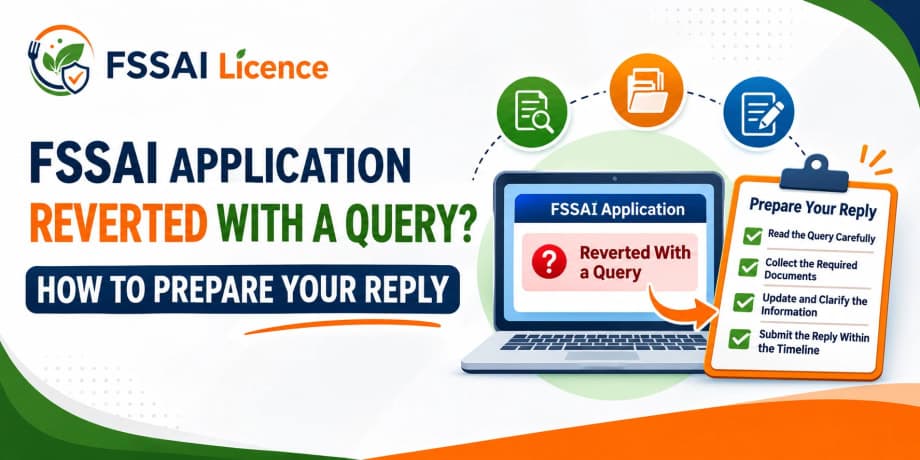
If your food licence application has been reverted with a query, open the application on the Food Safety Compliance System (FoSCoS), read the authority’s remarks and prepare a point-by-point reply with the evidence requested. Submit the response through the available application workflow within the deadline stated for your case, and retain proof of submission.
A reverted application generally signals that the authority wants further information or correction; it does not, by itself, tell you that a licence has been granted or that a final rejection has been issued. The useful starting point is the actual remark and the action available on your application, not a standard reply copied from another business.
1. FSSAI application reverted query reply: what the status means
1.1 Read the status alongside the remarks
FoSCoS is FSSAI’s online system for food business registration and licensing. A query can concern a missing explanation, a field in the application, a supporting record or the activity described by the food business operator. The status label tells you that attention is needed; the remarks tell you what the authority wants you to address.
Read the complete application record rather than relying only on an email subject line or a message forwarded by an agent. Note who raised the query, the application reference and the exact wording of every point. If there is more than one remark, treat each as a separate request even when a single response area is available.
1.2 Identify the decision you need to make
A response is suitable when the application remains open for clarification and you can accurately supply what has been requested. A final rejection is a different decision: read its reasons and the options stated in the order rather than assuming the same reply route remains available.
Likewise, a status showing only that an application is pending does not establish that a query has been raised. This guide focuses on preparing a reply to an actual query, not on chasing an application that is merely awaiting review.
2. Who can respond and what should be checked first?
The response should come from the applicant or a person authorised to act for that food business. The person preparing it needs access to the relevant FoSCoS application and enough information to make statements the business can support. An adviser can assist, but the operator remains responsible for the accuracy of the submission.
Identify the legal applicant named in the existing application and the person authorised to respond for it.
Establish which premises and food activities the application covers.
Check whether the application concerns registration or a state or central licence, and whether that route reflects the business facts.
Read all current remarks and any response instructions attached to the application.
Determine whether the requested change can be made in the available workflow or needs a different route.
2.1 Check the applicant and the activity
Eligibility for registration or a particular licence depends on the applicable FSSAI criteria and the facts of the operation. These can include the nature and scale of the business. A restaurant, manufacturer, trader or importer should describe what it actually does; a familiar label such as “food business” alone does not settle the category.
Form A is associated with registration and Form B with licensing. The form originally submitted helps identify the application you are replying to, but its existence does not prove that the selected category was correct. Review the relevant FSSAI eligibility criteria against the current business before asserting that a category is appropriate.
2.2 Know when a different route may be needed
If the query reveals a fundamental issue with the applicant, premises or licence category, do not assume that typing a clarification will convert the application into a different one. The available correction route depends on the application and the authority’s instructions. Where a change cannot be made in the existing workflow, establish the appropriate route before committing to a new filing or payment.
For example, a change in the person operating a business raises a different question from a spelling correction. The first may affect who should hold the authorisation; the second may be resolvable by explaining and correcting the record. The facts and the authority’s directions determine the next step.
3. Documents to prepare for the authority’s query
There is no single set of FSSAI application reverted documents for every business. Use the remark, the applicable FSSAI checklist and the nature of the operation to decide what is needed. The following records are a preparation guide; they are not a claim that every item is mandatory for every reply.
Application record and query: Keep the application reference, submitted particulars and complete remarks together. They identify the file and help you match the reply to the authority’s request.
Written clarification: Prepare a concise response identifying each point and the answer. It gives the reviewing officer context for any attachment.
Applicant or business records: Where the query concerns the operator’s identity or constitution, use relevant records that establish who operates the business and support the name used in the application.
Premises records: Where the question concerns the food business address or its right to use the premises, provide the relevant address or occupancy evidence requested for that case.
Activity and product information: Where the authority asks what the business does, prepare a factual description of the operations and products covered by the application.
Operational records or plans: If a query asks for a plan, report or other technical material, provide the relevant record for the operation and the point raised. Manufacturing and food-service applications can require different supporting information.
Authority-specific material: Include any additional declaration or record expressly requested in the notice, provided it is accurate and relevant to the applicant.
3.1 Prepare usable files
Use the file types, size limits and any naming or format instructions shown in the applicable FoSCoS workflow. If the authority asks for a particular form or format, follow that instruction rather than assuming a scan of a different record is interchangeable. A document should be readable in full, including its relevant dates, signatures and address details where those matter to the query.
Give each file a clear name that identifies its purpose, such as an address record or an activity description. Keep a copy of the exact version submitted. If a record contains several pages, arrange them so the reviewer can find the relevant passage without guessing which page supports the answer.
Avoid attaching an entire business archive to answer one narrow question. Select the relevant material and identify the part that answers the remark. Additional records can be useful when they explain the point, but unrelated attachments can make a straightforward reply harder to review.
4. How to draft a clear clarification
4.1 Use a point-by-point structure
An FSSAI licence clarification reply should let the officer move from the remark to the answer and then to its evidence. Begin with the application reference and applicant name. Reproduce or accurately summarise the first query, state the factual answer, and identify the relevant attachment or corrected field; then repeat that structure for each remaining point.
Keep statements specific. “The requested document is attached” is less useful than identifying what the document establishes and where the relevant information appears. If a request has more than one part, answer each part separately, including an explanation of any part that cannot be supplied as requested.
Do not make a declaration that the operator cannot substantiate simply to close the query. If the wording is unclear, frame the response around the facts you can establish and seek clarification through the channel indicated by the authority. Do not treat silence or an attachment alone as an answer to a question requiring an explanation.
4.2 Illustrative reply
Hypothetical: A food business has been asked to clarify whether its premises are used only for packing or also for preparing food. Its accurate reply could read:
“With reference to the query on activities at the premises, the business packs the food products listed in the application. It does not prepare or cook food at this premises. The attached activity description identifies the packing and storage operations conducted there.”
That example is useful because it answers both sides of the question and points to supporting material. It is not a declaration for another business to copy: a business that also prepares food must describe that activity accurately and consider its effect on the application.
Before submitting, make a simple private cross-reference: one line for each query, the answer given and the file or field that supports it. This makes an unanswered sub-question easier to spot without adding unnecessary text to the authority’s reply.
5. Submit the response through FoSCoS
Use the official FoSCoS application associated with the food business and follow the actions available for that specific file. Screen labels and permitted edits can differ by application and workflow, so the sequence below describes the task rather than promising a particular button name.
Open the application: Sign in to FoSCoS, locate the application using its reference and open the current status and remarks. Make sure you are working on the intended premises and application.
Review the response route: Read the instructions shown for the query, including which fields can be edited and where explanations or supporting files can be supplied.
penaliit
Make permitted corrections and attach evidence: Use the available fields and upload functions for the relevant changes and files. Where the required correction is not available in the workflow, do not substitute an unrelated edit.
Review and submit: Check that the response is complete, the intended files are attached and the application particulars are accurate. Use the final submission action offered by the portal; saving a draft or selecting a file alone should not be treated as proof of submission.
Retain the result: Keep the portal acknowledgement or other visible confirmation, together with the application reference, submitted reply and file copies. Record the submission date and the status displayed after submission.
5.1 Before final submission
A person preparing a reply for a company or another operator should arrange an internal review by someone who knows the business facts. The reviewer should assess the actual text and attachments, not merely approve the intention to reply. This is especially useful where an outside representative has access to the portal but does not manage the premises.
If the portal does not provide an expected field or upload route, record what the screen shows and use the support or contact route indicated by FSSAI or the authority. Avoid filing a second application merely because an action is difficult to find; first establish what has happened to the existing file.
5.2 After final submission
Check the application for the resulting status and any further communication. A copy of the reply and the acknowledgement are operational records: they help the business show what was sent and respond consistently if another question follows. They do not replace the licence or registration certificate.
6. Government charges and professional costs
Separate the cost of the original food licence application from the cost of preparing a reply. The supplied official reference does not establish a universal government fee for every query response, so it would be misleading to quote a fixed resubmission charge. Any payment request should be read in the context of the actual FoSCoS transaction and application.
Government application charge: The original application may have involved a charge based on its applicable category and period. Keep the payment record with the application reference.
Further government payment: Do not assume either that a reply is always chargeable or that every change is free. Read any payment demand generated for the particular transaction and understand what it covers.
Supporting-record expense: If a relevant report, professional drawing or replacement record has to be obtained, its provider may charge separately. That is different from a government application fee.
Professional assistance: An adviser may charge for reviewing remarks, preparing a response or managing a filing. These are private service charges, not FSSAI charges.
6.1 Ask for a written scope
If you engage help, ask what the quoted amount includes: reading the query, drafting, coordinating records, uploading, follow-up and handling any further remark are separate tasks. Also establish who pays third-party costs and whether another charge applies if the work expands. A written scope makes it easier to compare assistance with doing the reply yourself.
Where the existing application cannot be corrected and a different filing route is necessary, assess the cost of that route separately. Do not assume that an earlier payment automatically transfers to a new application or that it is automatically lost; the applicable transaction and decision determine what happens.
7. Deadlines and processing milestones
7.1 Find the applicable response date
Use the deadline shown in the notice or application record and read any instructions on how it is calculated. The material supplied for this guide does not establish one universal FSSAI resubmission deadline for all reverted applications. A commonly repeated number should not override the date or directions that apply to your file.
Allow time for the operator to review the reply and for any required supporting record to be prepared. If the available time is inadequate or the direction is unclear, raise the issue through the contact route stated for the application rather than assuming that an extension has been granted. Retain the communication and any written response.
7.2 Understand what happens after a reply
Submission is one milestone, not the final decision. The authority may review the clarification, request something further, arrange any applicable assessment or issue a decision. The time involved varies with the question, the completeness of the response and the review required; the supplied evidence does not support a reliable current benchmark for every case.
Monitor the application and the contact details used for official communication. If another query is issued, read it on its own terms: it may ask about a new point or explain why an earlier answer was insufficient. If the authority issues a final order, the order and applicable rules govern the available next steps.
8. Common mistakes and how to correct them
An FSSAI licence objection reply is most useful when it resolves the issue the authority has identified. The following failures require different corrections; sending the same generic sentence for all of them will not address the underlying problem.
Answering only part of a combined remark: A request may ask what happens at the premises and seek a supporting record. Address both parts separately, or explain accurately why a requested item cannot be supplied.
Leaving a factual inconsistency unexplained: If names or addresses differ across records, establish which details are correct and why the difference exists. Correct the underlying information where appropriate and explain the relationship; do not simply upload the same conflicting records again.
Describing the wrong activity: A product list or business description that does not reflect actual operations can leave the authority unable to assess the application. Reconstruct the activities conducted at the relevant premises and use accurate particulars in the permitted fields and reply.
Submitting material that does not answer the request: A document may be genuine but irrelevant to the question. Identify what the officer asked the record to establish, then supply the pertinent evidence or a factual explanation of its absence.
Treating a fundamental category issue as a typo: An unsuitable application route may not be fixed by changing wording in a cover note. Determine what correction the workflow permits and follow the appropriate route rather than asserting eligibility without support.
Stopping at a draft: A prepared response that has not been finally submitted may never reach the reviewer. Use the available final action and retain its confirmation.
Do not alter or create a record to make it appear consistent with an inaccurate application. A defensible correction starts with the true business facts and explains the discrepancy to the authority.
9. After a decision: operating with the right authorisation
9.1 If the application is approved
Obtain and review the issued registration certificate or licence for the applicant, premises, activities, validity and any conditions stated on it. A reply acknowledgement is evidence of a submission; it is not the authorisation itself. Keep the issued document accessible to the people responsible for the premises.
Section 31 of the Food Safety and Standards Act, 2006 provides the statutory framework for licensing and registration of food businesses. The applicable FSSAI rules, licence conditions and food safety requirements continue to matter after approval. The operator should implement the conditions relevant to its activities, including applicable hygiene and food safety controls, rather than treating the certificate as the end of compliance.
Assign responsibility for monitoring validity and for identifying changes to the business that may need action under the applicable FSSAI requirements. A manufacturer, restaurant and trader can have different operational duties, so the business should use the conditions and rules relevant to its own operation.
9.2 If the authority issues another decision
Read the complete order and its reasons. A further query calls for a response to the new points; a final decision may identify a different route or remedy. Preserve the order and the submission history so that the business can assess its position on the actual record, without assuming a particular appeal period or outcome.
10. Your next three actions
Open the current application and identify every outstanding remark and the response date stated for your case.
Prepare a point-by-point answer and assemble only the records needed to support the facts; arrange a business-side review before submission.
Submit through the available FoSCoS workflow and retain confirmation. If the issue involves an uncertain application route or you need help managing the work, consider assistance with FSSAI Registration; agree the scope and charges before engaging a provider.
Begin the process online via the official government portal, or engage FSSAI Licence for end-to-end assistance