Licenses
✍️ Akansha • 23 November 2026 • 16 min read
FSSAI Licence Application Pending for Weeks? What to Check Before Following Up
Get Free Consultation
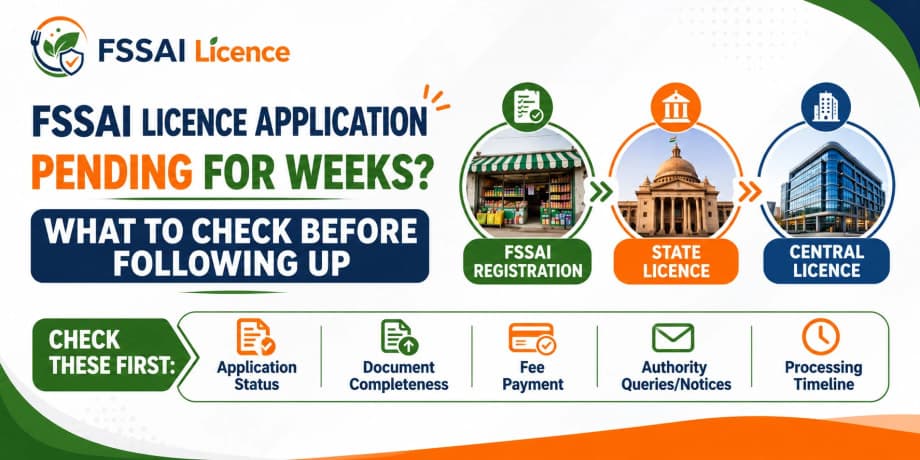
If your FSSAI licence application has been pending for weeks, first check its latest status and the last action recorded in FoSCoS. Establish whether the next step rests with you, the licensing authority or a technical support team; then follow up with the application reference number and a short timeline of events.
A pending food licence application is not itself an issued licence. Keep the application acknowledgement available, but do not treat its reference number as the licence or registration number that appears on an issued certificate.
1. FSSAI licence application pending: identify who needs to act
“Pending” describes an unfinished application, not necessarily a fault. The useful question is what the file is waiting for. An application awaiting examination by an officer calls for a different response from one awaiting information from the applicant or one affected by a portal-access problem.
Start with the exact wording visible in FoSCoS and any accompanying remarks or notices. Record the date you saw them: a status viewed today may describe an event that happened earlier. Where the portal provides an application history, the history may tell you more than the headline status alone.
1.1 Read the status in context
What you can see | What it may mean | Useful next move |
|---|---|---|
Application under scrutiny or processing | The file is shown as being reviewed; the label alone does not establish the review outcome. | Look for a dated remark or an outstanding applicant action before asking the authority for an update. |
Request for information or clarification | The authority has identified something requiring a response. | Read the actual notice and use the response route and deadline stated for your case. |
Inspection-related status | An inspection step may be relevant to the application. | Look for a notice or scheduling information; do not assume an inspection date has been fixed. |
Approval, rejection or another final outcome | The application may no longer be awaiting an initial decision. | Open the available order or certificate and read its particulars rather than relying only on the summary label. |
Unable to access or find the application | The problem may be with the reference details, account access or the portal. | Keep evidence of the issue and use the relevant support route. |
These are reading aids, not promises that every application will display the same labels or move through the same sequence. A FoSCoS application pending approval can also contain an instruction in a notice that is not obvious from a brief status description. Open the available details before deciding that the authority has all it needs.
1.2 Reference number versus certificate number
The application reference identifies the filing you are tracking. The licence or registration number belongs to the approval once it has been issued. This distinction matters when contacting an office: supplying the reference helps identify the pending file, while saying that you already have a licence number when you do not can make the request confusing.
If a representative submitted the application, ask for the acknowledgement and a copy of the submitted particulars. You need enough information to identify the file and understand what was submitted, even if the representative continues to handle the correspondence.
2. Who needs registration or a licence?
2.1 Choose the right approval
Food businesses in India need the applicable FSSAI registration or licence for their activity. Section 31 of the Food Safety and Standards Act, 2006 sets out the licensing and registration framework. The appropriate category depends on the business and the applicable eligibility rules; a restaurant, a manufacturer and an importer should not assume that turnover alone settles every case.
FSSAI’s system distinguishes registration from state and central licences. The relevant choice can depend on the nature and scale of operations and other criteria applicable to the business. For a cloud kitchen, for example, the question is the actual food-service activity and its circumstances, not simply whether the business has dine-in seating.
A pending application does not establish that the chosen category is correct. If the business has changed its activities since filing, make a note of the change and consider how it affects the approval sought. Do not represent an activity as authorised merely because it was described in an application.
2.2 Check the business scope
Before a fresh filing, identify the operating entity, the premises and the activities for which approval is sought. A trader who also repacks food, or a manufacturer who has added another operation, should assess the actual activities rather than rely on a broad business description. Businesses with more than one location should also consider how the applicable requirements relate to each location.
If an existing application appears to use the wrong category, avoid assuming that a second application will solve the problem. The appropriate correction depends on the file and the authority’s instructions. The mistakes section below explains how to approach that situation without losing track of the original case.
3. Documents and records to keep ready
The records needed for a follow-up are different from the supporting documents needed for a new application. Keeping these groups separate prevents you from sending a large file when the officer only needs enough information to locate the case.
3.1 Application and follow-up records
Application acknowledgement or reference: identifies the particular submission. Keep the original electronic acknowledgement or a legible copy.
Submitted application copy: shows the business name, premises and activities as filed. An electronic copy is useful when discussing the case with a representative.
Payment record: helps identify the payment associated with the filing. Retain the portal receipt or transaction record that is available to you.
Status and notices: preserve the displayed wording, remarks and dates. A dated screenshot or saved notice can show what was visible when you followed up.
Correspondence: keep any response or acknowledgement received from the authority, helpdesk or filing representative, together with its date.
Keep copies in a folder named for the business and application. If there are several premises or applications, label each folder separately. This makes it easier to send the correct reference and prevents an update on one file being mistaken for an update on another.
3.2 Supporting material for a new filing
Document requirements vary with the category and activity. The application may ask for material establishing the identity of the applicant, the business or the premises; certain activities may also require operational details or other supporting records. The relevant FoSCoS application identifies the information and uploads required for that filing.
Prepare legible electronic copies in the formats and within the limits specified in the application. Use the source documents to enter particulars accurately, and keep the originals or reliable copies accessible. Do not assume that every manufacturer-specific record applies to a small food-service business, or that a short registration checklist covers an importer’s licence application.
4. How to check status and submit an application
4.1 Track an existing application
For an FSSAI application status check, use the official Food Safety Compliance System, FoSCoS. The steps below are designed for an existing file; you do not need to begin a fresh filing merely to find out where that file stands.
Locate the application acknowledgement and the reference number for the particular filing.
Open FoSCoS and use the application-tracking facility, or sign in to the account used for the application where its details are available.
Enter the requested reference details and any other information the screen requires.
Read the displayed status and available remarks.
Open relevant notices or the application history where available.
Record the latest dated event and whether it asks for action by the applicant.
Save a copy of the status or note its wording and date.
Decide whether the next step is a response within the application, an authority follow-up or a technical support request.
FSSAI application tracking by reference number is useful only if the number relates to the right submission. If a search does not locate the file, compare the number with the acknowledgement and ask the person who filed it for the original record. A failed search by itself does not prove that the application was rejected or never submitted.
If an instruction is visible, use the route specified in the notice or application. An email asking for an update is not necessarily a substitute for the response mechanism required for that file. Keep the acknowledgement of any response you submit.
4.2 If you have not submitted yet
FoSCoS is also the official channel for applying online. Choose the applicable registration or licence route for the business, complete the fields and uploads requested for that application, and complete the submission and payment steps shown. Preserve the acknowledgement generated for the submitted application so that you can track it later.
Do not confuse a draft or an incomplete payment step with a completed application. If a representative is handling the filing, agree who will retain account access and who will monitor notices after submission. The business remains responsible for knowing what stage its application has reached.
5. Processing time: which dates matter?
There is no reliable way to predict the decision date for an individual file from a generic “pending” label. The supplied source material does not establish a current, universally applicable processing benchmark for every registration and licence route, so a precise number of days would be misleading here.
Instead, distinguish the time since initial submission from the time since the last meaningful action. A file submitted several weeks ago may have had a more recent response, inspection-related event or authority remark. Both dates can be relevant when you ask for an update.
5.1 Build a useful timeline
Write down the submission date, the dates of any notices, the dates on which the business responded and the date of the latest status you can see. Add any inspection communication or appointment date that has actually been notified. A short chronological record lets the recipient see the present stage without reconstructing the whole application from emails.
If the latest event is an applicant response, record what acknowledgement is available for it. If the last event is an authority notice, distinguish the date of that notice from the date you first read it. Do not infer an extension, a completed response or a decision from silence.
5.2 Why an application may take longer
Different files can involve different forms of examination or premises-related steps. An FSSAI licence pending inspection may need coordination that a file without that step does not. The status alone does not reveal the authority’s internal workload or establish that the business has caused the delay.
A notice can also change what happens next: the authority may need to consider a response before it can proceed. If you cannot see whether an action was received or what stage follows it, frame that as a specific question in your follow-up. Avoid describing the entire period since submission as time during which the officer took no action unless the record actually supports that statement.
For a useful follow-up, quote two dates separately: when the application was submitted and when the most recent notice, response or inspection communication occurred. That gives the recipient a clearer starting point than “pending for weeks.”
6. Government fees and professional charges
A food licence application can involve an official charge for the relevant registration or licence and a separate charge if you hire someone to assist. The amounts depend on the applicable application and current official fee schedule; the evidence supplied for this guide does not establish figures to quote reliably.
Government fee: the amount shown for the applicable application on the official system or in the current official schedule. Keep the official payment record.
Professional fee: an agreed charge for services such as preparing, filing or following up on the application. It is separate from the government fee.
Possible additional work: ask a service provider whether responding to notices, handling an inspection-related matter or later changes are included in its quote. These are questions about the provider’s scope, not automatic government charges.
When comparing quotes, request a breakdown showing the official payment, the service charge and any applicable taxes or separately billed work. A single “all-inclusive” amount can otherwise hide what you are paying the government and what you are paying the provider.
A pending status alone does not establish that another government fee is due. Nor does it establish that a professional has agreed to unlimited follow-up. Review the payment record and the service agreement before authorising any further payment; use the official application’s instructions for any payment it actually requests.
7. Mistakes that make a pending case harder to resolve
Treating the summary status as the whole file. A short label may not show the full instruction. Open the available notice and history, then act on the specific request rather than guessing from the label.
Using the wrong application reference. A representative may manage several files for the same business. Match the reference to the submitted premises and application before sending correspondence; otherwise an office may be unable to identify the case you mean.
Assuming an unanswered request has no deadline. An authority notice may specify a response period. Read the notice promptly, follow the stated route and retain proof of the response. A missed deadline can affect the application; the consequence depends on the applicable rules and the case.
Ignoring an apparent category or scope error. An application that does not reflect the actual operation may need attention. Identify the discrepancy and seek the appropriate correction or instruction for that file rather than quietly filing another application in the hope that one will succeed.
Sending an untraceable follow-up. A message containing only a business name and “please approve” gives the recipient little to work with. Include the reference, current status and last relevant date, and ask one clear question.
Assuming a technical failure is a regulatory decision. An error screen or inability to sign in is not the same thing as a rejection order. Preserve the error details and route the access problem separately from a request for the authority’s decision.
Do not submit a duplicate application solely because the first appears delayed. Two live references for the same proposed approval can make correspondence and payment records harder to reconcile; establish the status of the first file and the appropriate route before starting another.
8. How to follow up with the right authority
Once you have identified the current stage, direct a processing question to the authority handling the application through the contact or communication route available for that case. For a licence application, this may involve the designated officer or the office concerned. A registration application may be handled through the relevant registering authority; use the details shown in the application or official communications rather than assuming every case goes to the same office.
8.1 Make the request actionable
State the business name, application reference, approval type and premises as they appear in the filing. Add the submission date, the latest status and the date of the last relevant event. If there was a notice or inspection communication, identify it briefly rather than attaching every record in your possession at the outset.
Ask for the information you need to move the case forward: whether any action is outstanding from the applicant, whether an inspection step has been scheduled where relevant, or how the pending stage will be communicated. Keep the wording neutral. A request for an update is more useful than an unsupported allegation that an officer has deliberately held up the file.
For example, a follow-up can read: “Our application reference is [reference]. The application was submitted on [date], and the latest status shown on [date] is [status]. The last communication recorded was [brief detail]. Please let us know whether any action is outstanding from us and how we can receive the next update.” Replace the bracketed fields with your own details before sending.
Keep a copy of the message and any acknowledgement. If a further follow-up becomes necessary, refer to the earlier communication and any reply rather than sending an unrelated new description of the case. If you decide to make an FSSAI licence delay complaint, distinguish a request for an update from a complaint about a particular issue, and use the applicable official channel and instructions.
8.2 Use the helpdesk for technical problems
A helpdesk request is suited to a portal problem, such as an error that prevents you from accessing the application or submitting an available response. Describe the action you were trying to perform, the time of the attempt, the displayed error and the application reference. Include a screenshot if the support channel accepts it, taking care not to share passwords or unnecessary personal information.
Technical support and the authority deciding the application have different roles. Resolving an access error does not itself approve the food licence; conversely, an officer considering a file may not be able to fix an account-access problem. Keep the support acknowledgement and the authority correspondence separately so that each issue remains traceable.
If an agent is following up, agree on who sends each communication. Ask for copies of messages and replies rather than relying on a verbal assurance that the file is “in process.” One clear contact history is easier to manage than overlapping requests that give different dates or describe different applications.
9. What to do after approval
When the application is approved, obtain the issued licence or registration certificate and read it in full. Check the entity name, premises, authorised activities and validity details against the business’s actual operations. Keep an accessible copy and address any apparent error through the applicable official route.
Approval is the start of continuing compliance, not a substitute for it. Operate within the scope of the issued approval and meet the food-safety conditions applicable to the business. Requirements concerning display, labelling and other obligations depend on the activity and applicable rules; an application acknowledgement should not be used as a substitute for the issued particulars.
Record the certificate’s expiry date and assign someone responsibility for monitoring renewal. If the business later changes its premises, activities or other relevant particulars, assess the applicable modification requirements rather than assuming the original certificate automatically covers the change. Retain the final certificate alongside the application history so the business can distinguish its current approval from its earlier pending file.
10. Your next three actions
Retrieve the acknowledgement and identify the exact application and premises. If an agent filed it, obtain the submitted copy and the latest available status.
Read the latest notice and dated event. Respond through the stated route if the applicant has an outstanding action; otherwise prepare a focused update request for the office handling the file.
Keep the authority follow-up separate from any technical support request. If the business has not yet applied, or needs help with an appropriate filing, consider the scope and cost of FSSAI Registration assistance before engaging a provider.
Begin the process online via the official government portal, or engage FSSAI Licence for end-to-end assistance