Licenses
✍️ Akansha • 23 November 2026 • 15 min read
FSSAI Licence Application Rejected After Inspection? What Should a Food Business Do?
Get Free Consultation
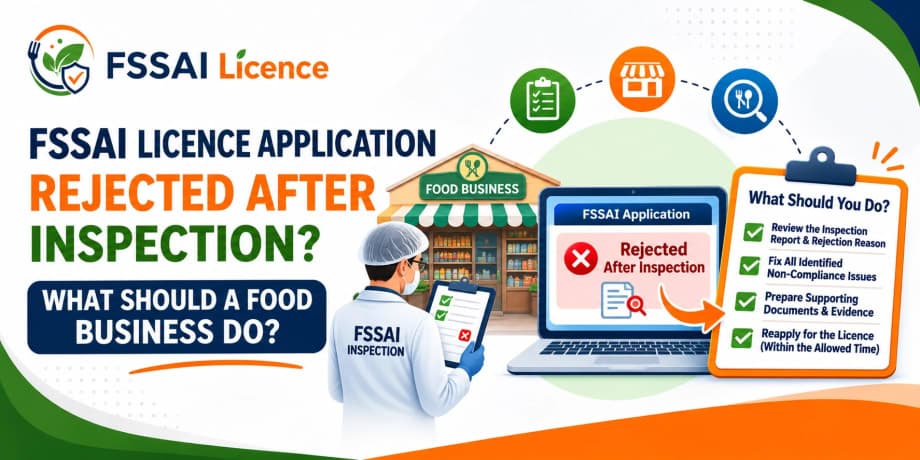
If your FSSAI licence was rejected after inspection, obtain the written decision and the inspection findings first. Then decide whether to challenge the refusal or correct the identified deficiencies and pursue a fresh application; an inspection observation alone is not necessarily a final rejection.
A food licence decision can turn on what was found at the premises, what activity the application described and whether you had an opportunity to answer the authority’s concerns. Your next move should address the actual finding, not merely repeat the original application. This guide covers the records to collect, the routes available, likely cost categories and the steps needed to keep a corrected operation compliant.
1. FSSAI licence rejected after inspection: identify the decision
1.1 Inspection finding, objection or rejection order
An inspection may produce a list of observations before the licensing authority makes its decision. An officer may also seek a reply or further information while an application remains open. A rejection order is different: it records a decision refusing the application, rather than simply identifying a concern that requires attention.
Open the application in the Food Safety Compliance System, known as FoSCoS, and read both the current status and the underlying communication. A short status label may not explain which condition was found deficient, whether a response is invited or who made the decision. Save the complete communication rather than relying on a screenshot of the dashboard alone.
What you have received | What it tells you | Immediate focus |
|---|---|---|
Inspection observations | What the officer recorded at the visit; the application may still be under consideration. | Read each observation and identify what evidence or correction it calls for. |
Request for a response | The authority wants information or action before proceeding. | Follow the communication’s instructions and stated response date. |
Rejection order | A decision has been made on the application. | Read the reasons, decision-maker’s details and any stated remedy before choosing the next route. |
1.2 What the order changes
The Food Safety and Standards Act, 2006, provides for licensing under Section 31. The provision addresses refusal of a licence, including the applicant’s opportunity to be heard and reasons recorded in writing. Keep the order and any earlier notices together: their dates and wording matter if you believe the finding or the procedure was wrong.
Do not assume that a message from an inspector, a portal label and a signed order are interchangeable. If the portal does not show the underlying decision, seek the relevant communication from the office handling the application. The record will help you determine whether the appropriate next action is a reply, a challenge or a new filing.
2. Who can take the next step?
2.1 Check the applicant, activity and premises
The next application must reflect the food business that will actually operate. Identify the legal applicant, the premises and the activities carried out there. A manufacturer, a restaurant, a trader and an importer may face different classification and supporting-information requirements; a business performing more than one activity should account for its full scope.
Identify the person or entity responsible for the food business and the premises concerned.
List the activities, products and scale that the application must cover, including any intended change since the original filing.
Determine whether the operation falls under registration, a State licence or a Central licence under the applicable FSSAI criteria.
Consider whether the previous refusal concerns the same applicant, site and activity, or whether those facts have materially changed.
Check whether the decision or an applicable restriction affects the proposed next route.
2.2 Licence or registration
Section 31 distinguishes licensing from registration for eligible petty food businesses. The right category depends on the applicable criteria for the business, not on whether the proprietor would prefer a simpler application. Turnover can be relevant, but activity, capacity and other criteria may also matter.
For example, a trader should not select a category solely by comparing turnover with a restaurant’s position; the actual kind of business and its regulatory classification matter too. If the business has outgrown or changed the scope described in an earlier filing, reassess the category before spending money on a new application. The same assessment matters when an FSSAI registration was rejected after a site visit.
3. Documents to assemble and what each should show
3.1 Original decision record
Start with a readable copy of the application acknowledgement, the submitted application and the final order or current request. Together, these identify the file, the applicant’s original declarations and the authority’s stated concerns. Preserve the complete document, including dates, signatures and any annexures, in its original electronic form where available.
The inspection report, inspection checklist or written observations provide the detail needed to connect a finding with a response. If photographs or other material accompanied the inspection, retain those as well. A personal note of what happened during the visit can help reconstruct events, but label it as your own account rather than as an official finding.
3.2 Evidence for the next filing
The exact attachments depend on the application category, activity and issues raised. The following records are useful where relevant; this is a preparation list, not a claim that every item is compulsory for every food business.
Finding-by-finding action record: A dated table or note identifying each observation, the action taken, the person responsible and the evidence available. Its purpose is to let a reviewer trace the response to the finding.
Premises photographs: Clear, dated images of the affected area before and after work, where available. Include enough context to identify the location rather than sending an unexplained close-up.
Repair or installation records: Invoices, work orders or completion notes for relevant changes. These support the description of work; they do not by themselves prove that the arrangement is suitable.
Operating records: Cleaning schedules, maintenance logs, pest-control records or staff instructions relevant to the finding. Completed records show how the control operates after installation.
Test or service reports: A relevant report where the activity, applicable rules or authority’s request calls for one. Retain the full report, including the sample identification, date and issuing organisation.
Application-specific records: Identity, business, premises and activity information required for the selected filing. Use the current FoSCoS requirements for that category rather than assuming another business’s checklist applies.
Use legible files in the formats and sizes accepted by the submission channel. A corrected layout or explanation should describe the actual premises as it now exists. If an earlier record remains accurate, keep it available; if the underlying facts have changed, prepare an updated record rather than presenting the old one as current.
4. How to respond or apply again
4.1 Preparation
First decide which findings you accept and which you dispute. A deficiency that can be fixed physically may call for a corrective plan. A finding based on an incorrect description of the site, a disputed observation or a procedural concern may require a reasoned representation or legal challenge instead. Both issues can exist in the same case.
For each accepted deficiency, decide what must change before submission and who will maintain the change afterwards. For a disputed finding, identify the specific statement you contest and the material that supports your position. Avoid submitting a broad assertion that the premises is compliant without addressing the individual observations.
4.2 Submission
Sign in to FoSCoS and locate the application using its reference details.
Read the available communication and determine whether the file is open for a response or has been refused.
If a response is invited, use the channel stated in the communication.
Address the points in the same order as the authority’s observations and submit within the time stated in that communication.
If a final refusal is disputed, examine the order and applicable legal route before filing a challenge.
Section 31 is relevant to licence refusal; the correct forum, procedure and time limit depend on the decision and governing rules.
If a fresh filing is appropriate, select the correct registration or licence category on FoSCoS and complete the applicable application.
Form A is used for registration and Form B for a licence under the FSSAI licensing framework.
Submit through the applicable channel, retain the acknowledgement and payment record, and note the new application reference separately from the earlier one.
A fresh application should accurately reflect the current premises and activity. Where the submission permits or requires an explanation of the earlier decision, identify it accurately and explain the relevant change. A new reference number is useful for tracking, but it does not erase the earlier findings.
4.3 After submission
Monitor the application for communications from the authority and keep the person responsible for the premises available to coordinate any further visit. If the authority asks for clarification, respond to the point actually raised and preserve proof of submission. Do not assume that uploading a file is complete until the channel provides an acknowledgement or other indication that the response was submitted.
An appeal and a new application serve different purposes. A challenge asks the competent authority to consider an error in the decision; a fresh filing asks for a decision on a new application. The order, the governing procedure and the facts determine how those routes interact, so do not assume that filing one automatically pauses the other or extends a deadline.
5. Government charges and other costs
Budget for the next step in separate buckets. A government application charge, a professional’s service charge and the cost of making the premises compliant pay for different things. A quote that combines them can make it difficult to see what is payable even if the application is not approved.
Cost item | What to establish before paying |
|---|---|
Government application fee | The amount shown for the selected category and application on the official channel, including the chosen licence period where relevant. |
Professional assistance | The agreed scope, fee, taxes if applicable, and whether responding to later queries or attending an inspection is included. |
Premises corrections | The cost of repairs, equipment, cleaning, maintenance or other work needed for the specific findings. |
Reports and supporting work | Charges for any relevant testing, technical drawings or other evidence required for the application or response. |
Challenge-related expense | Any applicable filing charge and the cost of representation or preparing the case for the appropriate forum. |
The supplied information does not establish a universal refund rule for a rejected application. Do not deduct the earlier payment from your budget for the next filing unless the applicable payment terms provide for it. Likewise, a fresh application should not be assumed to be free merely because the earlier one was refused.
Ask a service provider for a written breakdown before engagement. In particular, distinguish preparing an application from rectifying the premises: an adviser can help organise a filing, but a service fee does not automatically cover plumbing, equipment or other physical work.
6. How long can the next decision take?
There is no reliable single turnaround estimate for every post-inspection case in the material available here. The route matters: answering an open request, challenging a refusal and filing a fresh application are different proceedings. Each can also depend on the nature of the food business and the authority’s need for further scrutiny.
Plan around milestones you can identify: receipt of the written decision, completion of corrective work, submission of the chosen response or application, acknowledgement, and any subsequent request or inspection. Record the date of each milestone. This gives you a useful basis for a focused follow-up without treating an informal estimate as a legal deadline.
Physical work can be the largest variable. A cleaning problem may be addressed differently from a drainage defect, a change in equipment layout or a disputed finding that requires a formal challenge. Staff availability, contractor schedules, testing where applicable and the authority’s review can all affect the elapsed time.
Section 31 contains provisions concerning licence applications and their timing, but their application depends on the statutory conditions and the facts of the case. A pending application or passage of time should not be treated as blanket permission to operate. Establish the legal position for the specific application before commencing or resuming food business activity.
7. Inspection failures: causes and corrective action
Schedule 4 of the Food Safety and Standards (Licensing and Registration of Food Businesses) Regulations, 2011 sets out hygiene and sanitary requirements. The relevant provisions depend on the kind of food business. Use the applicable part as an operating checklist alongside the actual inspection findings, rather than treating a generic list as proof that the premises has passed.
7.1 Premises and equipment
Surfaces that cannot be cleaned effectively: Damaged or unsuitable food-contact and nearby surfaces can make routine cleaning ineffective. Repair or replace the affected material, then introduce a cleaning method appropriate to the surface and activity.
Water or drainage concerns: An inspector may identify a problem with water used in the operation or with wastewater disposal. Trace the source and affected use, arrange the necessary correction, and obtain relevant evidence where the applicable requirements call for it.
Inadequate separation: Raw materials, finished food, waste and cleaning chemicals can create contamination risks if handled without appropriate separation. Redesign the flow or storage arrangement for the actual activity and ensure staff can follow it during busy periods.
Pest entry or harbourage: A one-time treatment may leave the cause untouched. Address entry points and conditions that attract pests, then maintain a suitable monitoring and control arrangement.
7.2 Controls in daily operation
Cleaning without a working system: A clean floor on inspection day does not show who cleans equipment, how often or what happens when a task is missed. Assign responsibility and maintain records suited to the operation.
Unsafe handling or storage: Review how food moves through the premises, including storage conditions and handling practices relevant to the products. Correct the practice itself and give staff instructions they can use during normal service or production.
Waste accumulation: Provide an appropriate way to collect and remove waste without contaminating food or food-contact areas. Check whether the arrangement works at the business’s busiest time, not only when the premises is empty.
7.3 Application and scope errors
Wrong category or activity: If the application describes a smaller or different operation from the one inspected, the authority may be unable to assess it under the selected category. Reassess the actual operation and use the appropriate classification.
Inconsistent records: Conflicting applicant names, addresses or activity descriptions can make it unclear which entity and premises are being assessed. Resolve the underlying discrepancy and use consistent, accurate information in the relevant records.
Drawings that do not match the site: A layout that omits an operating area or shows a different arrangement is of limited value to the reviewer. Update it to reflect the real flow and features relevant to the application.
Treat each finding separately. Repainting a room, for example, does not resolve a drainage problem, and a new cleaning log cannot substitute for repairing equipment that cannot be cleaned properly. The corrective record should show both the change made and how the control will continue.
8. After approval: keep the premises compliant
Approval is a point in time, not a substitute for daily food safety controls. Assign a named person to maintain the corrective actions, review records and report failures. For a small business that person may be the owner; for a larger operation, responsibility may be divided among production, maintenance and quality staff.
Keep the licence or registration details accessible and comply with applicable display and record requirements.
Maintain the hygiene controls relevant to the activity, including the measures introduced after inspection.
Review changes in products, process, capacity, premises or business details against the scope of the approval and applicable modification requirements.
Track the licence validity and begin renewal planning before expiry, where renewal is applicable.
Investigate recurring failures and record the corrective action, rather than repeatedly treating the symptom.
If a contractor handles a control such as maintenance or pest management, the food business still needs to know what was done and whether it works. Review the service record against conditions actually observed at the site. A report filed away without follow-up will not prevent a repeat finding.
Keep staff involved when the operation changes. Moving equipment, adding a product line or changing the way food is stored can affect how the premises functions. Update relevant instructions and records so the approved operation and the one carried out on the ground do not drift apart.
9. Choose your next three actions
Secure the decision record. Retrieve the written communication and identify whether you have an open request or a final refusal. Note any date or remedy stated in it.
Choose the route. If the finding is wrong or the refusal procedure is disputed, consider a challenge through the applicable forum. If the finding is correct and remediable, complete the work and assess whether a fresh filing is appropriate.
Allocate responsibility. A straightforward correction and filing may be manageable in-house. Consider specialist help where the licence category, technical remediation, disputed evidence or appeal procedure is unclear. For filing support, see FSSAI Registration.
Begin the process online via the official government portal, or engage FSSAI Licence for end-to-end assistance