Licenses
✍️ Team Fssai Licence • 13 July 2026 • 4 min read
What Are the Penalties for Operating Without an FSSAI Licence?
Get Free Consultation
The Food Safety and Standards Act 2006 (FSSA) of India, is the umbrella legislation under which the government has put all the food laws together. It consolidated 8 different food laws into a single framework and foremost authority is the FSSAI.
Under section 63 the provisions cover the scope and applicability to different categories of food business. It also specifies conditions and requirements for compliance. The documentation and record keeping obligations along with inspection and enforcement of framework and lastly FSSAI Licence penalties for non compliance. Our experts can help you navigate the process easily and also keep a track of your application and renewal.
Who Must Comply with FSSAI Regulation?
Type of Food Business | Who Needs It? | Required FSSAI Approval |
|---|---|---|
Petty food manufacturers, street food vendors, hawkers, and small retailers (annual turnover up to INR 1.5 Crore) | Yes | FSSAI Registration (Basic Registration – Form A) |
Medium-sized food businesses (annual turnover aboveINR 1.5 Crore – INR 50 Crore) | Yes | State FSSAI Licence (Form B) |
Large food businesses (annual turnover above INR 50 Crore) | Yes | Central FSSAI Licence (Form B) |
Food importers | Yes (Mandatory) | Central FSSAI Licence, regardless of turnover |
E-commerce food sellers and food aggregators | Yes | State or Central FSSAI Licence, depending on business scale |
Hotels, restaurants, caterers, cafés, and cloud kitchens | Yes | FSSAI Basic Registration or State FSSAI Licence, based on turnover |
Home-based food businesses and cottage industries | Yes | FSSAI Registration (or a licence if turnover exceeds the prescribed limit) |
Legal Penalties for Operating Without an FSSAI Licence
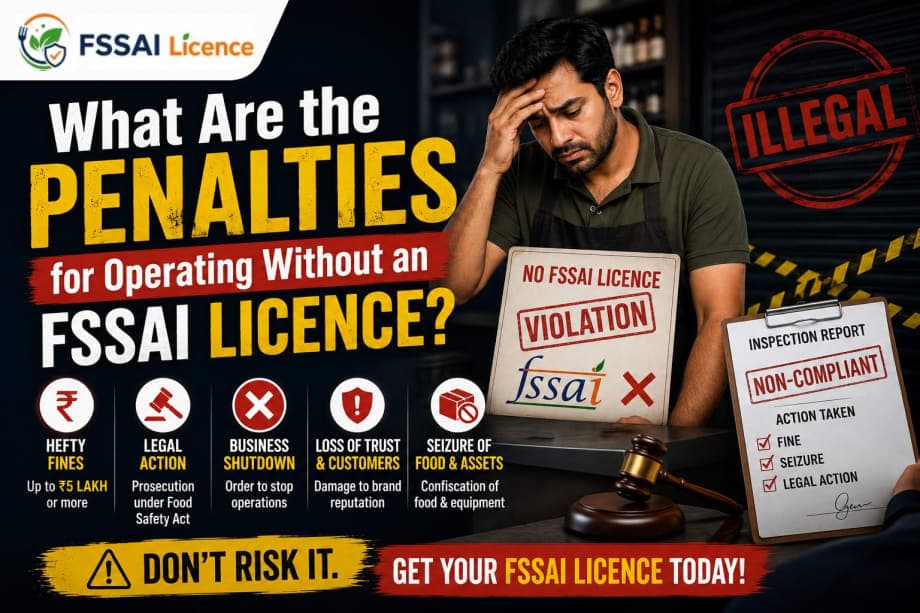
The FSSAI Licence penalty is imposed on businesses that start operating without valid approval from the authority. It is a punishable offence to run a food business without meeting the minimum criteria set by FSSAI.
Depending on the severity of the violation the business owner may face
- Imprisonment for up to six months
- Or both fine and imprisonment
The authorities determine the penalty based on the nature and level of the non compliance.
Enforcement Actions by Food Safety Authorities
The penalty for no FSSAI licence is not just limited to fines but food safety officers regularly visit the premises of food business to ensure they are meeting the licensing requirements.
Authorities can issue notices, seize the food products, suspend the operations temporarily or even impose a ban on the factory if they found discrepancies.
Impact on Business Reputation
Without an FSSAI Licence the credibility of the business and the CEO may take a big hit. A non compliant business may face loss of customer trust, poor branding, reduced sales and difficulty in attracting new customers. Even investors may shy away from the business if they find it is operating with a valid food license.
Why FSSAI Compliance Matters
FSSAI Compliance means that the business has adequately passed the quality checks that the government imposes to keep the citizens of India safe from adulterated food products. FSSAI compliance requires business to follow food safety and hygiene regulations like:
- Maintaining hygienic food preparation areas
- Proper food storage and handling training for employees
- Upto-date records of source of raw materials
- Renewing licence on time
Common Mistakes That Lead to Penalties
Obtaining a food safety licence can prevent avoidable mistakes and making unintentional violations. Some common mistakes FBOs make that attracts penalties are:
- Applying for the wrong licence category
- Starting operations before receiving approval
- Delaying licence renewal
- Failing to update licence details after business expansion
- Ignoring food safety and hygiene requirements
A food licence fine can place a significant burden on small and medium-sized businesses. Apart from statutory penalties, businesses may also suffer losses due to temporary closure, cancelled customer orders, spoiled inventory, and damage to their reputation.
The cost of obtaining a licence is much lower than attracting fines.
Conclusion
Business focused on expansion should get a valid FSSAI licence. It avoids serious legal, financial and reputational consequences. Understanding the FSSAI Licence penalty will help businesses to be aware and avoid the fines. Getting approval should be the top most priority for any FBOs.