Licenses
✍️ Team Fssai Licence • 13 July 2026 • 6 min read
What Happens If You Don't Have an FSSAI Licence?
Get Free Consultation
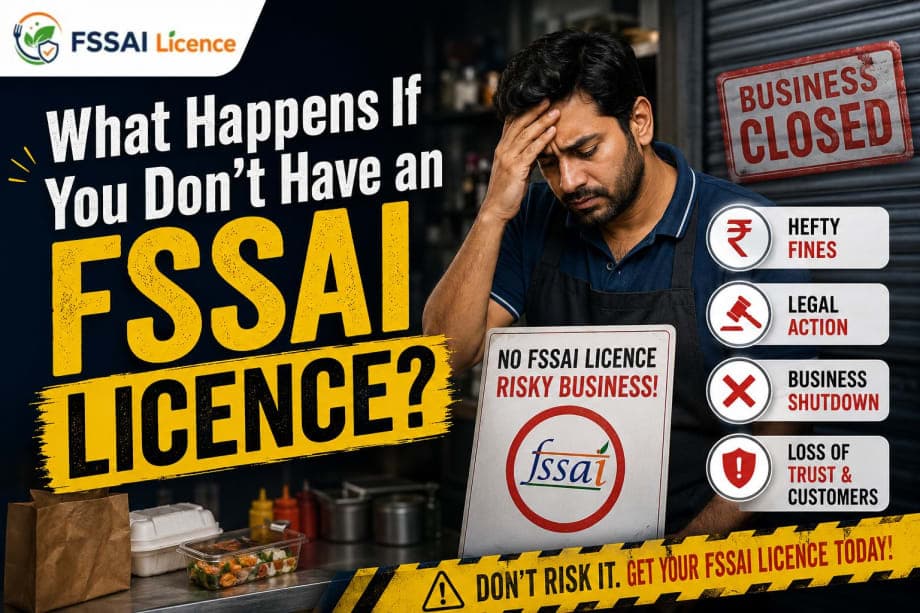
Owning a business like a restaurant, cloud kitchen, home bakery, food truck or a grocery store is exciting. Complying with India’s food safety laws is essential for your business to grow. One of the most important documents you require and cannot operate without is the FSSAI Licence. The Food Safety and Standards Authority of India regulates food business to ensure customer safety and food quality.
Obtaining an FSSAI Licence is not just a legal document or a formality but it protects your business from penalties. Most businesses are unaware that operating with a Licence can attract a fine of INR 5 Lakh. Extreme punishments like business closure and even imprisonment can happen. Here’s a comprehensive guide to explain everything you need to know about FSSAI registration: what it entails, how to get it and what happens if you don't have it.
What is an FSSAI Licence?
Under the Food Safety and Standards Act 2006, FSSAI Licences are issued. It allows eligible Food Business Operators (FBOs) to manufacture, process, store, transport, distribute and sell food legally in India. FSSAI was created to bring all food related laws under one umbrella law and make it based on science based evidence to regulate their manufacturing, storage and sale.
Depending on the scale of business there are three kinds of food Licences that are issued. Basic Registration, State Licence and Central Licence.
The three distinction on Licences depends upon
- Annual Turnover of the business
- Production capacity
- Business activity
Who Needs an FSSAI Licence?
Almost all FBOs require a food Licence before starting the business. Choosing the correct category for opening the business is important or else it may cause delays or rejection of the application.
Businesses that generally require approval are:
- Restaurants and cafés
- Cloud kitchens
- Home-based food businesses
- Caterers
- Hotels
- Food manufacturers
- Wholesalers and distributors
- Retail food shops
- Food importers and exporters
- Online food sellers
Its important to get an FSSAI Registration since it grants you a legal authorization to operate your business, consumers trust the credibility of your products, it helps in the onboarding process of Ecommerce websites. It eases the process of exports and access to business loans. FSSAI Licence also helps the business to get eligibility to MSME and Govt. Schemes.
How to get FSSAI Licence?
The FSSAI Licence depends on the turnover of the business. Here’s a table that explains in details about the differences in Licences
Category | Annual Turnover | Operational Scale & Production Capacity | Fee Per Annum |
|---|---|---|---|
Basic Registration | Up to INR 1.5 Crore | Small FBOs | INR 100 |
State Licence | INR 1.5 Crore – INR 50 Crore | Medium-scale operations operating within West Bengal | INR 2,000 – INR 5,000 |
Central Licence | Above INR 50 Crore | Large operations, importers/exporters, e-commerce vendors (Zomato/Swiggy partners), and multi-state operators | INR 7,500 |
The process of procuring a Licence is:
- Visit the official FSSAI FoSCoS Portal to get your food business licence.
- Click on Apply for New Licence/Registration on the yellow menu box to sign up or log into your existing account.
- Choose the state where your business operates, select your operational category (e.g., Manufacturer, Retailer, Food Service), and choose the correct capacity or turnover range.
- Fill the Application Form: Attach digital copies of all mandatory identity and business proofs.
- Pay the Application Fee.
- Save the 17-digit reference number generated upon payment to track your application.
- Then once approved, download your digital 14-digit FSSAI certificate directly from the portal.
Documents you may need:
- Identity proof like passport size photograph, Pan card, Voter ID of all the owners.
- Proof of Business Premises liek signed rental agreement or No Objection Certificate.
- Partnership deed, Proprietorship Declaration may also be needed.
- A printed layout of the blueprint of the factory, equipment list, water test analysis report and also the Food Safety management Plan (FSMS).
What Happens If You Don't Have an FSSAI Licence?
The Food Safety and Standards Act 2006 is very strict and can have serious consequences.
Legal Penalties
Under the section 63 of the Food Safety and Standard Act, if any business operates food business without FSSAI compliance, it can attract:
- Fine upto INR 5 Lakhs
- Imprisonment of the FBO upto 6 months.
- Other legal proceedings against the owner.
The severity depends on the nature of the violation.
Business Closure
If the authorities find any businesses operating without a proper approval from the authorities on inspection then they may,
- Issue notices.
- Suspend the operations.
- Seize the food products.
- Temporary closure until the criterias are met.
Loss of Customer Trust
Consumers nowadays are very conscious of the hygiene and quality of the food they put inside their body. They may verify the details before purchasing a product or ordering them online.
Without an approval from the Food safety authority, the customers may lose confidence in the product and not buy them. It may attract negative reviews online and reduce the demand of the products. Most important of all is the damage to the reputation of the organization.
Difficulty Expanding Your Business
Many e-commerce platforms, supermarkets, and distributors require businesses to provide valid Licence proof before doing business with them. Expansion of business can be hampered if a company cannot produce a valid FSSAI Licence.
Other problems the business can face includes:
- Loss of contracts with retailers
- Increased regulatory scrutiny
- Higher compliance costs in the future
Conclusion
Instead of waiting for an inspection or receiving a legal notice, it is always better to apply for the licence before starting your business. Following the rules protects your business, improves your reputation, and helps you grow confidently.
Getting a food business licence is essential for anyone starting a food business in India. It is a legal requirement that helps your business operate smoothly and follow food safety rules. Having a valid licence not only helps you avoid fines, penalties, and legal issues but also builds trust among customers by showing that your food meets safety standards.