Licenses
✍️ Akansha • 24 November 2026 • 15 min read
No Rent Agreement for Your Food Business Premises? What Address Proof Can You Check?
Get Free Consultation
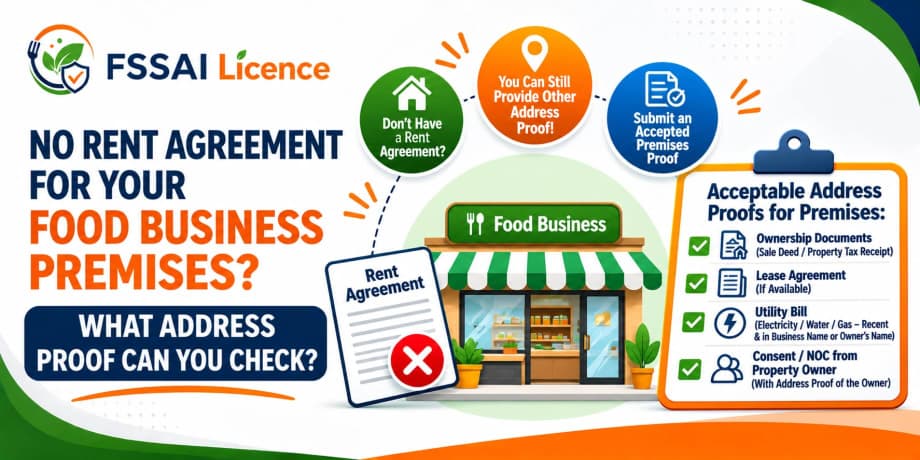
You can explore an FSSAI licence without a rent agreement if you can establish the address of your food business and explain your connection to the premises through other suitable records. A rent agreement is not the only type of premises record worth checking, but an alternative document is not automatically accepted in every case.
The right evidence depends on whether you own the property, operate from a family home, rent informally or share space with another business. This guide separates the premises question from the rest of your food licence application, so you can prepare a defensible submission and know what to do if FoSCoS raises a query.
1. Who can seek an FSSAI licence without a rent agreement?
1.1 Choose the application category
Food business operators must identify whether their activity calls for registration or a licence under the Food Safety and Standards framework. Section 31 of the Food Safety and Standards Act, 2006 deals with licensing and registration; the appropriate route depends on the nature and scale of the business and the applicable rules. The absence of a rent agreement does not itself decide the category.
A home kitchen, restaurant, food trader or manufacturer should assess the actual activity it intends to carry on. For example, a business that prepares food for delivery needs to describe its preparation activity, even if it has no seating area. A trader that stores goods should consider the premises used for storage as well as the address from which it manages orders.
Registration and State and Central licences are different routes. Turnover can matter to the choice, but it is not a complete substitute for examining the business activity and other applicable criteria. Use the current eligibility selection on FoSCoS rather than assuming that a small-looking operation always qualifies for registration.
1.2 Check the operating arrangement
FSSAI registration from home without a rent agreement can be relevant where food is prepared at a residential address. The applicant still needs an identifiable place of operation and an arrangement that permits the business to use it. A family member’s ownership, a shared kitchen booking or a verbal rental arrangement each raises a different question about who controls the space.
Before filing, identify the operator who will hold the approval, the precise place where the food activity happens and any other approvals applicable to that use. A food safety approval does not by itself replace permissions that may be required under other laws or property arrangements. Importers, exporters and operators with more than one site should also assess their complete operating model rather than treating a single address as an answer to every licensing question.
For a shared space, establish which parts of the premises the applicant may use and for what activity. The important distinction is between being allowed to visit or receive deliveries at a property and being allowed to run the proposed food operation there. Resolve that distinction with the person or organisation controlling the space before committing to the application.
2. Which FSSAI address proof documents can you check?
Think of the premises file as answering two questions: where is the food activity located, and how is the applicant connected to that location? One record may help with both; in other cases, a combination may tell a clearer story. The applicable FoSCoS checklist and the reviewing authority determine what is required and acceptable for the application.
Identify the complete operating address, including the unit, floor or identifiable portion where relevant.
Gather the available record that identifies the property or its address.
Gather evidence of the applicant’s connection to the premises, especially where the record is in another person’s name.
Prepare legible electronic copies and any other category-specific application records requested on FoSCoS.
2.1 Owned or residential premises
A sale deed or other ownership record can help identify the owner and property. For a self-owned premises application, it is useful to locate the relevant document before filing, including the pages that identify the property and owner. Follow the portal’s instructions on the file and details to provide; a summary made by the applicant is not the same thing as the underlying record.
A property tax receipt can help identify a property and the person recorded for that payment. It may not, by itself, establish every aspect of ownership or the right of a different applicant to conduct a food business there. Keep the complete receipt available, including the address and date, rather than relying on an isolated payment reference.
An electricity or other utility bill can help connect an address to a service account. If the account is in the applicant’s name, it may provide a useful link to the premises; if it is in a relative’s or owner’s name, it identifies that account holder instead. An electricity bill should not be treated as a guaranteed substitute for proof of the applicant’s right to use the property.
A government-issued identity or address record may identify the applicant and an address, subject to the applicable checklist. It serves a different purpose from a document recording who owns or controls the property. For a home kitchen, select records that relate to the place where food is actually prepared rather than merely the address used for personal correspondence.
2.2 Rented, family-owned or shared premises
A rent or lease agreement, where available, records the arrangement between the parties. Its absence does not make an ownership record or utility bill a rental contract. If the arrangement is undocumented, consider putting the permission to use the space in writing so the applicant can explain the basis of occupation accurately.
An owner’s no-objection letter, often called an NOC, can communicate that the owner permits the named operator to use an identified space for the proposed activity. Its value depends on who gives it, what authority that person has and what the letter says. It is a supporting record to consider, not a universal replacement for a premises document or a promise of approval.
A useful written permission identifies the parties, the relevant premises and the intended use. In a shared kitchen, it can also identify the portion or facilities the operator is allowed to use and the period or terms of that permission. If a manager signs on behalf of the owner or operator of the facility, their authority to grant the permission is a separate matter.
In a family-owned home, the business operator and property owner may be different people. Records that identify the property owner and a clear permission from that owner can explain the relationship more effectively than a document in the owner’s name alone. A family relationship does not itself turn the applicant into the owner of the premises.
For rented premises without a shop agreement, ask what records actually exist: correspondence granting use, payment records, an owner’s written permission or documents identifying the property. These records can help explain the arrangement, but their existence does not establish that each will satisfy the authority’s premises-proof requirement. Submit the record requested or permitted for the application, rather than assuming that any payment to a landlord is enough.
2.3 Other application records
Premises evidence is only one part of a food licence application. The portal may require details or records concerning the applicant, business constitution, food activities, products or operating facilities. Requirements vary by the selected activity and category, so the applicable FoSCoS checklist is the working list for the rest of the file.
Keep originals or reliable source copies accessible and prepare clear electronic versions for upload in the format and size allowed by the portal. Where a record has multiple relevant pages, retain them together so the property description, parties and signatures can be read in context. Do not alter a document to make it appear to say more than it does.
FSSAI has published an advisory concerning proof of premises for FoSCoS applications. The source material available for this guide does not establish the full text of that advisory, so the examples above are records to examine, not a definitive official list or a statement that a particular document will be accepted.
3. How to apply on FoSCoS
Use the Food Safety Compliance System, known as FoSCoS, for the online application. Form A is associated with registration and Form B with licensing under the Food Safety and Standards (Licensing and Registration of Food Businesses) Regulations, 2011. The applicable online workflow determines the information requested for the chosen route.
Prepare the business profile.
Identify the applicant, operating location, food activities and the premises arrangement. Keep the supporting file ready before starting the online application.
Start the appropriate application on FoSCoS.
Follow the portal’s eligibility and kind-of-business selections to reach the relevant registration or licence workflow. Enter the business and premises details in the fields presented.
Complete the applicable form and upload the requested records.
Review the information shown on the application screen and use the upload slots relevant to the selected activity. Add supporting information where the workflow permits it.
Review the application before payment and submission.
Check that the applicant can account for the information provided and that the selected activity reflects the intended operation. Use the portal’s displayed payment process for the applicable government charge.
Save the submission acknowledgement and application reference.
Keep a copy of the submitted details and monitor the application through the portal for communications from the authority.
Respond to any request for clarification through the available portal workflow.
Address the specific question raised and retain the response and any additional records submitted.
Separate preparation from submission: uploading a file is an application action, while assembling a record that accurately explains the premises is work to complete beforehand. Equally, a payment or acknowledgement records submission; it does not mean the authority has approved the food business.
If someone files for you, agree who will receive portal communications and who can access the application reference. The operator remains responsible for the accuracy of the business information. A service provider can help organise the filing, but the applicant should be able to review what is submitted in its name.
4. What will the application cost?
There is no single price for every food licence application. The government charge depends on the applicable application category and other selections shown in the relevant fee schedule or portal workflow. The supplied evidence does not establish current fee amounts, so a reliable estimate starts with the amount displayed for your selection rather than a fixed figure quoted without context.
Government charge: the amount payable through the official application process for the selected route and period, as applicable.
Professional fee: any separately agreed charge for preparing, filing or following up the application.
Supporting costs: any actual cost of obtaining, copying or preparing records, where needed.
Later work: charges for additional services, such as handling a query or a subsequent change, if these are outside the agreed scope.
Calculate your expected outlay by adding the applicable government charge, the agreed professional fee and any supporting costs. Ask for a written breakdown if you use an intermediary: a single package price can make it difficult to tell whether government payment, query responses or later changes are included.
For example, a quote described as “filing assistance” might cover only preparation and submission. A broader engagement may include responding to a document query, while a later premises change may be priced separately. Those are matters to agree with the provider, not fixed government charges.
Applicants who want help preparing a file can explore FSSAI Registration through FSSAI Licence. Request the scope and price before engaging the service, and retain the government payment and submission records for your business.
5. How long can the decision take?
Plan around milestones rather than treating submission as the approval date. Time is spent preparing the file, completing payment and submission, waiting for scrutiny, responding to any query and receiving the decision. If an inspection or additional examination is applicable, that can add another stage.
The time needed for your response is partly within your control. An applicant who has access to the person controlling the property and can obtain an explanation promptly is better placed to answer a premises query than one who must first reconstruct the arrangement. The authority’s review time and any inspection scheduling are separate from that preparation work.
The supplied evidence does not establish a current processing benchmark or a specific deadline for this application. Do not plan a launch around an assumed number of days. Use the status and communications on FoSCoS to track your individual application, and distinguish an acknowledgement from a registration or licence that has actually been granted.
Where an authority requests further information, read the request for the response method and any date stated in it. Keeping a record of when the request was received and when the response was submitted makes follow-up more precise if the application remains pending.
6. What mistakes can delay a premises review?
The consequences of a weak premises explanation can range from a request for clarification to an adverse decision, depending on the application and the authority’s assessment. These are distinct problems to identify before they appear in a query.
Different addresses across the application and records: abbreviations, missing unit numbers or a different building address can make it unclear which place is proposed. Correct the application details where the workflow permits and provide an explanation that links legitimate address variations to the same premises.
A document names someone other than the applicant without explaining the connection: the reviewer may be unable to see how the operator uses the location. Provide an accurate account of the relationship and a relevant supporting record if requested or permitted.
A permission describes the wrong activity or space: consent for an office or mailing address may not explain a food preparation or storage operation. Obtain a permission that accurately describes the intended use and the area involved.
The application names the wrong operator: a proprietor, company and individual owner are not interchangeable. Identify the entity actually carrying on the food business and correct the application through the available route.
An unreadable or incomplete upload obscures material details: an authority cannot assess a page it cannot read or a document missing its identifying information. Replace or supplement it through the portal workflow when allowed.
A query goes unanswered: the authority may be unable to finish its assessment on the material available. Assign responsibility for monitoring the application and respond to the specific request within any stated period.
Do not create or backdate a rent agreement to fill an apparent gap. If the arrangement has not been recorded, describe it accurately and obtain a genuine record of permission or occupation where appropriate.
A correction should solve the reviewer’s actual question. Sending more pages without identifying the issue can make the file harder to assess; a short explanation of the relationship between the operator, property and proposed activity is often more useful alongside the relevant evidence.
7. What must you manage after approval?
Approval is the start of ongoing food-safety compliance. Keep the issued registration or licence and its particulars accessible to the people responsible for the operation. Review the conditions attached to the approval and the applicable food safety requirements for the activities you conduct.
Operate within the particulars and activities covered by the issued approval.
Maintain the hygiene, food-handling and other applicable controls for the business.
Display the registration or licence as required and make the details available to the relevant staff.
Track the approval’s validity and arrange renewal before expiry through the applicable process.
Assess whether a change in premises, operator or activity requires a modification, fresh application or another action under the applicable rules.
Keep the premises arrangement under review as well. A permission that supported the original application may no longer describe the position if the owner changes, a shared-space arrangement ends or the business moves to another unit. Retain current records and assess the appropriate regulatory action for the actual change; do not assume that a document for the old location covers the new one.
For a growing business, assign responsibility for both food-safety controls and administrative records. A kitchen manager may know that storage has moved, while the person handling the licence may not. A simple internal notification before an operational change helps the business assess its approval position in time.
8. Your next three actions
Choose the operating arrangement that describes your business: self-owned, family-owned, rented or shared. Identify the person or entity that will operate the food business and the place where it will work.
Assemble the available premises records and use the applicable FoSCoS checklist to prepare the rest of the application. If rights to use the space are unclear, resolve the arrangement before presenting it as settled.
Decide whether to file yourself or obtain assistance. Self-filing may suit a straightforward file; support is more useful when the applicant, property controller and operating arrangement need careful documentation or when the business has several activities.
Begin the process online via the official government portal, or engage FSSAI Licence for end-to-end assistance