Licenses
✍️ Akansha • 26 November 2026 • 17 min read
Third-Party Manufacturer Has Not Provided an FSSAI NOC: What Should a Food Brand Do?
Get Free Consultation
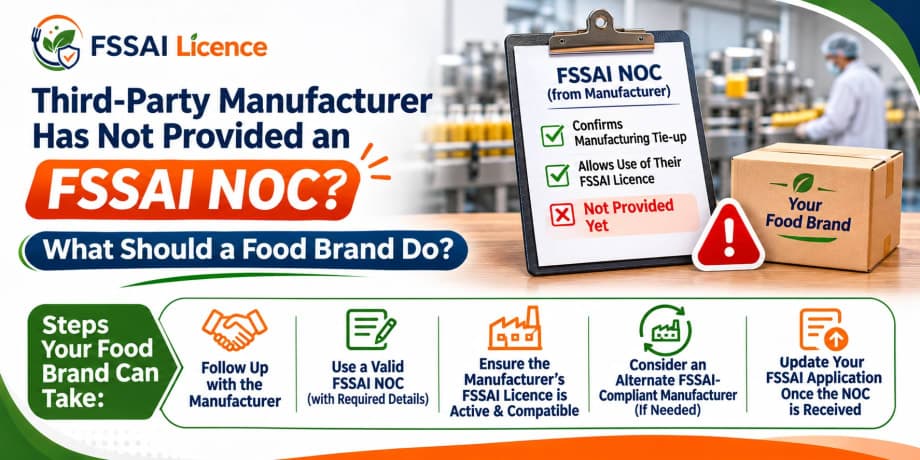
If your third-party manufacturer has not provided an FSSAI NOC, ask the manufacturer to respond to the consent request and resolve any mismatch in the business or product details. Do not treat an unanswered request as approval or assume that the manufacturer’s food licence covers your brand’s own activities.
Start by identifying whether your FoSCoS application requires manufacturer consent for the activity you have selected. Then separate three questions: has the manufacturer agreed, has your application been submitted, and has the licensing authority issued your licence? Each has different evidence and may require a different action.
1. FSSAI NOC from third-party manufacturer: what the missing consent means
1.1 What the NOC does
An NOC is a no-objection consent associated with the proposed relationship between a food brand and its third-party manufacturer. In an outsourced arrangement, the brand may arrange for food to be made or packed by another business and marketed under the brand’s name. The consent helps establish which manufacturer is associated with the products named in the application.
The NOC is different from the commercial contract. A contract may deal with price, production, recipes and responsibility for recalls; a consent addresses the manufacturer’s agreement to the stated relationship for the licensing process. Retain both when available, but do not assume that one automatically replaces the other.
1.2 A consent is not a licence
The manufacturer’s agreement does not itself grant the brand a food licence. FoSCoS is the Food Safety and Compliance System used for FSSAI registration and licensing; the relevant authority considers the application through that system. A manufacturer can agree to an arrangement while the brand’s application still requires other information or remains under examination.
Conversely, a manufacturer’s existing licence relates to its own authorised business. It does not automatically authorise a separate brand owner to undertake activities for which that owner needs its own registration or licence. Section 31 of the Food Safety and Standards Act, 2006 provides the licensing framework for food business operators, subject to the applicable registration and licensing rules.
For a reader searching for a “food licence”, the immediate decision is therefore not simply whether the factory has a certificate. Identify your own food-business activity and application status as well as the factory’s status.
2. Who needs the relabeller route?
2.1 Identify the actual business role
A private-label business may arrange for another operator to manufacture food that is sold under its brand. The relabeller category may be relevant to that arrangement. The precise selection depends on what the applicant actually does, the premises involved and the categories available for that activity in FoSCoS.
Do not select a manufacturing activity solely because your brand appears on the packet. Equally, do not assume that every trader, restaurant or importer must use the relabeller route merely because it sells food made by someone else. A restaurant selling meals it prepares, a trader reselling another company’s branded stock and a brand commissioning its own private-label product have different operating arrangements.
Where the selected application route asks for manufacturer consent, provide the consent in the manner required by the current application. The supplied evidence does not establish that an identical NOC requirement applies to every food-business category or every private-label arrangement. The presence of a requirement in your application is a reason to resolve it, not a reason to select a different activity that does not describe your business.
2.2 State versus central licensing
Registration, state licensing and central licensing are different routes. The applicable route depends on the business and the eligibility criteria relevant to it; a manufacturer’s licence level does not, by itself, determine the brand’s level. FoSCoS is the place to work through the applicable kind of business and eligibility choices before completing the application.
If the business has more than one activity or premises, map each to the relevant application rather than assuming that a single manufacturer NOC resolves the position everywhere. Record the legal entity applying, the address associated with the application and the intended activity before asking a supplier to consent.
3. Documents and details to collect before filing
The exact document list depends on the application route and information requested in FoSCoS. The following is a working checklist: some items support the application directly, while others are practical records that make it easier to establish the proposed arrangement.
Applicant identity and constitution details, including the legal name and the person authorised to act for the business.
The address and contact details of the premises relevant to the application, with supporting premises documents where requested.
The proposed kind of business and the food products or categories to be entered in the application.
The manufacturer’s legal name, facility address and FSSAI licence number, together with a copy of its current licence for review.
The manufacturer’s consent in the form or workflow required for the selected application, if requested.
The manufacturing or supply agreement, or a written summary of the proposed arrangement, as a practical reference for both parties.
Draft product labels and product specifications, so that the business names and descriptions can be compared with the application.
3.1 Applicant and premises
Use the applicant’s legal name consistently. A trading name can be commercially familiar while the licence application, agreement and supplier’s records identify a different legal entity. If an authorised employee handles the application, keep a clear record of who can approve changes and receive communications.
The premises in the brand’s application should reflect the premises relevant to its own activity. The contract factory’s address is a separate fact. Mixing those addresses can make it difficult for the manufacturer to recognise the request or for the authority to understand the arrangement.
3.2 Manufacturer, product and consent
For FSSAI manufacturer licence verification, compare the number, legal name, address, validity and permitted activity shown on the licence with the information you plan to use. Assess whether the proposed food products fit the manufacturer’s authorised scope. A certificate with a familiar company name is not enough if it relates to another facility or activity.
There is no universally applicable manufacturer NOC format established by the supplied official evidence. If a written consent is requested, it should clearly identify the parties and the proposed relationship and products, and follow the format or instructions applicable to that application. A generic letter saying only “no objection” may leave the parties and arrangement unclear.
Keep the agreement separate from the NOC evidence. It is useful for establishing what the manufacturer has commercially agreed to do, but it should not be presented as a substitute for a specific consent requested in the application.
4. How to move an NOC request and application forward
Use FoSCoS for the application, and follow the steps and prompts shown for the chosen activity. The current interface and required supporting evidence can vary; the sequence below describes the work to complete rather than promising that every application will display the same buttons.
Map the application. Identify the applicant, relevant premises, activity and licence or registration route. For a licence application, the prescribed application is Form B; registration applications use Form A, as applicable.
Enter the proposed arrangement. Supply the product and manufacturer details requested for the selected route, using the records collected for that particular facility.
Initiate or provide consent. If FoSCoS offers an online manufacturer-consent request for the application, use that workflow. If the application instead asks for a document, provide the consent as instructed there.
Ask the manufacturer to act. Send its responsible contact the applicant name, facility details, products and the relevant request reference or instructions. Ask for a clear response, not merely an assurance that the matter is being handled.
Complete the application. Provide the other required information and documents, pay the applicable charge shown in the process and submit when the system permits. Save the acknowledgement and application reference.
Monitor the application. Read any communication from the authority and respond through the indicated route within the time stated in that communication. Retain the final decision or issued certificate.
The online NOC request and the licence application are related but distinct. A request sent to a manufacturer establishes that you asked for consent; it does not establish that consent was granted. Likewise, a submitted Form B and payment acknowledgement are evidence of filing, not evidence that a licence has been issued.
For a useful follow-up, give the factory a single contact person at the brand and a concise list of the relevant details. If a consultant or employee is operating the account, agree who will monitor responses. A request can remain unattended when the person who negotiated the commercial deal is not the person responsible for the manufacturer’s regulatory account.
5. When the manufacturer does not respond or refuses
5.1 Diagnose the hold
First determine whether the problem is silence, a technical or identification issue, a refusal by the manufacturer, or a communication from the licensing authority. These are different events. Ask the manufacturer for the actual reason in writing and record the date, contact and response rather than relying on a verbal update such as “it is pending”.
If the manufacturer cannot identify the request, compare the facility and applicant details with the information supplied to it. If its commercial team agreed but its compliance team has concerns, ask which part of the proposed arrangement is disputed. The brand may be using a product description, facility or legal name that the manufacturer did not expect.
If the manufacturer refuses, ask whether it objects to the relationship itself or only to the details entered. A correctable data issue calls for a corrected request or application information through the available process. An unwilling supplier requires a commercial decision; repeated reminders cannot create consent.
5.2 Escalate or replace the supplier
Escalate within the manufacturer’s organisation to the person responsible for regulatory compliance and the person authorised to approve the contract. Give them a business deadline tied to your planned production or filing date. That deadline is a commercial management tool, not an FSSAI statutory response period.
Where the supplier will not cooperate, consider an alternative facility that is willing and appropriately licensed for the proposed products. First determine whether you can amend the existing application or need another permitted route. A replacement affects more than the name on a form: specifications, packaging, production schedules and contractual commitments may all need to change.
Do not describe a manufacturer’s refusal as a licensing-authority rejection. If the authority has issued a query or decision, read that communication separately; it may specify a response route or a deadline. If there is only supplier silence, the immediate task is to resolve the supplier relationship and application details.
6. Costs: government charges versus commercial costs
Budget for the application and the supply arrangement separately. The government amount depends on the applicable route and particulars shown in the current process. The supplied evidence does not establish a current tariff for every relevant case or a separate charge for an online manufacturer NOC, so no fixed NOC fee should be assumed.
Government application charge: The applicable registration or licence charge is determined by the route and application particulars. Use the amount shown in the official FoSCoS process for your case.
Professional assistance: A service provider may charge separately for preparing, reviewing or tracking the application. Ask for the scope, exclusions and whether official charges are included.
Manufacturer charges: A supplier may quote commercial setup, documentation or production charges under its own terms. These are not automatically government fees.
Correction or change costs: A changed application or later modification may have an applicable official charge. The amount and route depend on the transaction.
Switching costs: Changing factories can require fresh packaging work, new specifications, revised purchase commitments and internal review before production can move.
Ask for an itemised quote before paying anyone. A useful quote separates money paid to the government from the provider’s fee and from the manufacturer’s commercial charges. It should also explain what happens to the service fee if the supplier refuses consent or the application needs to be revised.
A search for “central food licence fees” may produce a single headline figure, but that does not establish the total cost of this project. The brand must first identify its own route; it should then budget for both the official application and the commercial work needed to make the proposed supply arrangement operational.
7. Timing, due dates and evidence of completion
There are several clocks, and they should not be merged into one promised turnaround. The manufacturer’s response, the completeness of the application and the authority’s examination can each affect the overall schedule. The supplied evidence does not establish a universal number of days within which every manufacturer must answer an NOC request.
Milestone | When to act | Evidence to retain |
|---|---|---|
Consent request | Before the application step that requires consent | Request reference or copy and the details sent to the manufacturer |
Manufacturer response | By the business deadline agreed with the supplier, if any | The consent or response in the form available for the application |
Application submission | When required information is complete and submission is permitted | Application reference, submitted particulars and payment acknowledgement |
Authority query | Within the period stated in the communication | Query, response, supporting documents and acknowledgement |
Licence or registration | Before undertaking activity for which it is required | Issued licence or registration certificate and its validity details |
Renewal or change | According to the applicable rules and the certificate’s status | Renewal or modification records and the updated certificate where issued |
Build a working calendar from actual dates: your planned launch, the manufacturer’s agreed response date, any authority deadline and the validity of relevant licences. Do not substitute a supplier’s estimated response time for a deadline stated by the authority. Assign a named owner to each milestone so that a query does not sit in an unattended account.
Evidence also answers a different question at each stage. An email shows that the brand followed up; it does not prove the factory agreed. A payment receipt shows a transaction; it does not prove the authority granted the licence. The issued certificate is the record to examine for the final licensing position.
8. Compare your options while consent is outstanding
Option | When it fits | Limit or cost |
|---|---|---|
Wait and escalate | The manufacturer accepts the arrangement but has not completed its response | Launch timing remains dependent on a third party |
Correct the details | The parties agree, but the request does not describe the intended entity, facility or product accurately | Use the correction route available for the application; retain the revised record |
Change manufacturer | The existing supplier refuses or cannot support the proposed arrangement | Requires a new commercial and regulatory review, plus possible packaging and production changes |
Change the business model | The brand genuinely intends to perform a different food-business activity | The new activity must be assessed on its own facts; changing a selection on paper does not change the business |
A “licence without manufacturer NOC” is not a shortcut to assume when your selected application asks for that consent. Establish whether the selected activity reflects your operation and whether the portal requirement applies to it. If it does, resolve the requirement or change the underlying arrangement through an appropriate route.
Consider the cost of a supplier change before cancelling an existing order. For example, a brand may own printed packaging that names one facility. Moving the same recipe to another factory can require changes to that packaging and to the supply plan, even if the product’s consumer-facing name stays the same.
9. Mistakes that turn a delay into a compliance problem
Using the wrong facility’s details: A company may operate more than one site. Match the proposed production location to the licence and request rather than using a convenient head-office address.
Ignoring a product-category mismatch: A broad commercial description and the regulatory product category may not convey the same scope. Resolve the discrepancy before asking the manufacturer to approve an inaccurate relationship.
Copying an unrelated NOC: Consent for another brand, facility or product does not establish agreement to your arrangement. Obtain evidence that identifies the actual parties and proposed activity.
Assuming a pending request permits operations: The status of a supplier request does not itself provide the brand with a licence. Determine what authorisation is required for the activity before starting it.
Missing an authority communication: A query and a supplier reminder are different. Track the authority’s stated response instructions and deadline separately.
Calling every negative status a rejection: Preserve the actual message or decision and identify who issued it. The appropriate correction depends on whether the issue is with the supplier, application details or authority review.
Operating a food business without a licence where one is required can have consequences under the Food Safety and Standards Act, including Section 63. A pending or refused NOC alone should not be described as automatically attracting that penalty; the facts and the applicable authorisation requirement matter.
If you discover that operations have already started, establish what activity is being carried on, which entity is doing it and what authorisation it holds. Preserve the records rather than altering them retrospectively. The correction path depends on those facts and on any communication already received from the authority.
10. After approval: keep the arrangement current
A licence is a starting record, not a permanent description of every future arrangement. Keep the issued certificate accessible and compare its particulars with how the business operates. Calendar its validity and maintain the renewal evidence applicable to your licence or registration.
Give one person responsibility for reviewing changes before they happen. A new manufacturer, facility, product or activity may affect application or licence particulars and may require a change through the applicable process. Decide the regulatory and operational steps before placing a production order or releasing revised packaging, rather than treating the paperwork as an afterthought.
The contract should also allocate practical responsibilities. Record who controls specifications, approves label artwork, retains production and distribution records, handles complaints and coordinates a withdrawal or recall if needed. Contractual allocation helps the parties act quickly; it does not automatically remove legal responsibilities that apply to either operator.
Maintain traceable links between purchase orders, manufacturer details, product specifications, batches received and customers supplied. If a product issue arises, those records help identify the affected stock and the parties who must be contacted. Keep the manufacturer’s relevant licence information and your own application and consent records with that file.
11. Your action list for the next decision
Today: Identify the applicant, intended activity and current FoSCoS status. Locate any Form A or Form B application reference and the latest authority communication.
Before your next supplier follow-up: Match the proposed facility and product details against the manufacturer’s records. Ask a named regulatory contact for a response to the consent request.
By your internal decision date: If the manufacturer agrees, complete the applicable application steps. If it refuses or cannot support the arrangement, decide whether to correct the details or assess another supplier.
When an authority sets a deadline: Record that exact date, submit the requested response through the indicated route and retain the acknowledgement.
Before launch or a material change: Establish the authorisation needed for the activity and retain the issued certificate and relevant change records.
For help with a registration or licence application, visit FSSAI Licence. Review your current compliance status and take corrective action before the due date