Licenses
✍️ Akansha • 26 November 2026 • 15 min read
FSSAI Licence Application Asking for a Water Test Report? What Should Food Businesses Check?
Get Free Consultation
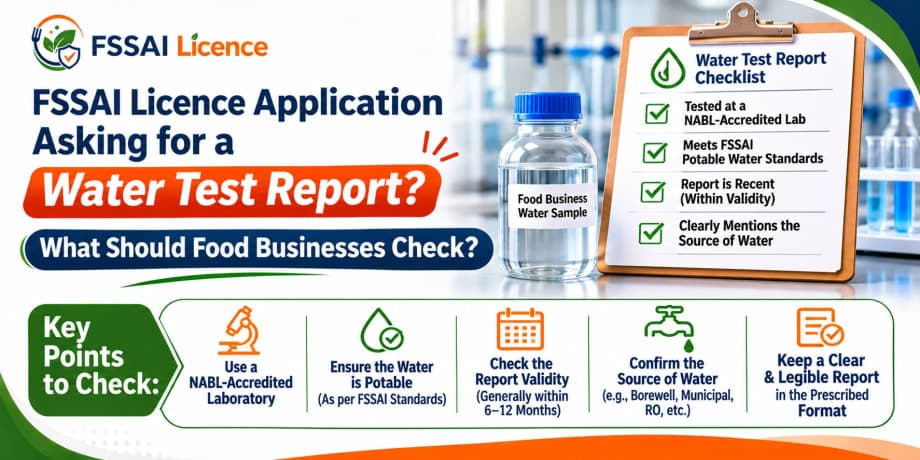
A water test report for FSSAI licence applications is not a blanket document for every food business. Whether you need one depends on the activity, how water is used, and the applicable FoSCoS checklist or query; a business that uses water in processing should pay particular attention to the requirement.
If your application asks for a report, identify the water source and sampling point, arrange the applicable tests with a suitable laboratory, and review the results before uploading the report. Keep the laboratory charge separate from the government food licence fee and allow time for any follow-up or corrective work.
1. When is a water test report for FSSAI licence applications needed?
1.1 Start with the activity and use of water
The first question is what happens to water at the premises. Water may become an ingredient, be used to make ice, wash food, clean equipment or serve customers. Those uses affect the water-safety assessment; they do not automatically mean that every applicant faces the same upload requirement.
A water quality report for a food manufacturing licence is particularly relevant where water enters the product or is used in processing. A kitchen or restaurant should also consider the water used in preparation and on food-contact surfaces. A trader handling only sealed packs has a different activity profile from a unit that opens, prepares or processes food.
For water testing for a restaurant FSSAI licence, describe the actual operation rather than relying on the word “restaurant” alone. A kitchen making drinks and ice uses water differently from a premises storing sealed beverages. The applicable application checklist and any specific licensing query determine what evidence is requested for that application.
1.2 Consider the business and premises
Registration, state licensing and central licensing are different application routes. The appropriate route depends on the applicable business category and scale, among other conditions. The presence of a water report does not, by itself, decide which route applies.
Identify the food activities carried out at the particular premises, including processing, preparation, storage and trading where relevant.
Identify each water source and the uses that could affect food or food-contact surfaces.
Determine the applicable registration or licensing category from the current FoSCoS eligibility options.
Review the document requirement for the selected activity and any specific request raised on the application.
Source matters too. A municipal connection, a private supplier and an on-site borewell do not necessarily present the same evidence question. Do not assume that a water bill replaces a test report, or that a report is required in every case merely because the premises has a tap.
For packaged drinking water and other specialised categories, the product and process can trigger additional requirements. A general food-business water report should not be treated as a complete statement of the requirements for those activities.
2. What documents should you prepare?
2.1 The laboratory report
Where a report is applicable, obtain the complete FSSAI water analysis report issued by the laboratory, rather than a payment receipt or an informal message saying that the sample passed. The report is evidence of the sample examined and the results obtained; it should be readable as a standalone document.
Useful identifying details include the customer or premises, the stated water source or sampling location, sample collection and receipt dates where recorded, the report date, the tests performed and their results. The laboratory’s identity and report authentication also help the reader understand who issued it. Retain all pages, including notes that explain the limits or test methods.
There is no universal FSSAI water test report format established by the supplied source material. Use the format issued by the laboratory and satisfy any applicable checklist or query. For a digital submission, keep a clear, complete copy in a file type and size accepted by the portal.
2.2 Supporting application records
The rest of the FSSAI licence application water testing documents depends on the application. Have the business’s identity and constitution information, premises details and activity information ready in the form required for its selected category. The portal checklist may call for further records specific to the operation.
Premises information: identifies the location for which the application is made and connects the activity to the establishment.
Business and authorised-person information: identifies the applicant and the person submitting or signing the application, as applicable.
Activity and product details: describe what the establishment does and help determine the relevant document checklist.
Source and sampling information: records where the tested water came from and where the sample was taken; retain any laboratory sampling record supplied.
Other category-specific records: support the particular application when FoSCoS requests them; they should not be assumed to apply to every applicant.
A water bill or supplier record can help identify the supply arrangement. Its function is different from a potable water test report for an FSSAI licence: it identifies a supply or transaction, while a laboratory report describes tests on a sample. Whether either is acceptable evidence in a particular case depends on the applicable requirement.
Keep the original electronic report and an organised copy with the application records. If the business has more than one establishment, store the evidence under the correct premises so that a later reviewer can identify which operation it relates to.
3. How do you select a laboratory and decide what to test?
3.1 Accreditation and scope
Before booking an FSSAI water testing laboratory, explain the activity, the water source and the exact request you are trying to satisfy. Ask the laboratory for a written quotation identifying the proposed tests, sampling arrangements and report delivery. A quotation lets you compare what is included rather than comparing prices alone.
If considering an NABL accredited water testing laboratory for FSSAI purposes, ask whether its accreditation scope covers the relevant water tests. Accreditation for one activity or parameter should not be assumed to cover every proposed test. Also establish whether the applicable application requirement calls for a particular kind of recognised laboratory; accreditation alone should not be treated as proof that every filing requirement is met.
Ask who collects the sample and what identification the laboratory will put on the report. Laboratory collection and customer collection can involve different instructions and charges. The laboratory can explain its sampling protocol and any limits on what it can conclude from a sample it did not collect.
3.2 Sampling point and test panel
A source description and a sampling point answer different questions. “Municipal supply” describes where water comes from; a kitchen outlet after a storage tank and filter describes where a sample is taken. Treatment, storage and distribution within the premises can affect whether a source-level sample represents the water used in an operation.
Map the route from source to use before deciding where to sample. If a plant has separate treated and untreated lines, or a kitchen has more than one source, discuss that arrangement with the laboratory. A single sample should not be assumed to represent every line or every location without a basis for doing so.
Searches for FSSAI water testing parameters often combine chemical and bacteriological testing into one assumed package. The relevant panel depends on the applicable requirement and the purpose of the test. Ask the laboratory to specify the parameters in its quotation and report rather than ordering an unnamed “FSSAI package”.
IS 10500 is a drinking-water standard that may be relevant to an applicable requirement. The supplied material does not establish a complete, universally applicable panel or exclusions for every food business. Identify the standard and parameters required for the particular application before commissioning the work; do not infer that every report labelled “IS 10500” covers the same tests.
3.3 Reading the results
An FSSAI chemical and bacteriological water test report may contain several results, units, methods and reference limits. Read the result against the limit and interpretation shown for the relevant test, rather than relying only on a report title. Where the report qualifies a result or identifies a limitation, keep that qualification with the report.
A laboratory result describes the sample examined. It is useful evidence about the selected water and sampling conditions, but it cannot by itself establish that every outlet remains suitable indefinitely. If a result is unclear, ask the issuing laboratory to explain the finding and its report before using it to make an operational decision.
4. How do you prepare and submit the application?
4.1 Before submission
Make the preparation stage a separate task from the FoSCoS filing. This gives the laboratory time to complete its work and gives the business an opportunity to act on an adverse result before treating the report as application-ready evidence.
Map the operation. Record the establishment’s activity, water uses, source and relevant points of use. Choose the application route that fits the business.
Identify the applicable evidence. Review the current checklist for the selected category and read any specific query carefully. If the wording is unclear, seek clarification through the appropriate licensing channel rather than guessing.
Commission the test where needed. Agree the sampling arrangement, tests, quotation and delivery with the laboratory. Give it accurate premises and source information.
Review the completed report. Consider the results and the report’s scope. Resolve any operational concern before relying on the water for the affected use.
Complete the online application. Use the Food Safety Compliance System, FoSCoS, enter the relevant business details and attach the documents requested for the selected application.
Pay and retain the submission record. Review the government fee shown for the application, complete the portal payment and save the acknowledgement and payment record.
Monitor the application. Read any clarification or document request in full, respond through the available portal process and retain the response and supporting evidence.
4.2 On FoSCoS
FoSCoS is the official online system for FSSAI licensing and registration. Form A is associated with registration and Form B with licensing; follow the electronic application presented for the route selected. The fields and attachments shown depend on the application, so use the current portal instructions rather than a generic list copied from another business.
For a FoSCoS water analysis report upload, use the relevant document slot or the response channel identified in the query. Read the slot description before attaching a file. If a report has several pages, ensure the submitted copy preserves the result tables and any notes needed to interpret them.
4.3 After submission
An acknowledgement shows that an application has been submitted; it is not the same as a licence being granted. Keep track of the application status and the contact details used in the filing so that a request for further information reaches the person responsible for responding.
If you need help with the wider filing, FSSAI Registration assistance can be considered alongside the official self-service route. The applicant should still understand the declared activities and the evidence being submitted.
5. What will the application and water test cost?
There is no single price for the complete exercise. The government charge relates to the selected registration or licence application; the laboratory and any adviser charge separately. Review the amount displayed for the actual FoSCoS application rather than assuming that a quoted package price is the government fee.
Cost component | What it covers | What to ask |
|---|---|---|
Government fee | The applicable registration or licence application charge. | What amount is shown for the selected category and period? |
Laboratory testing | Agreed sampling, analysis and reporting services. | Which tests, visits and report copies are included? |
Corrective work | Any investigation, treatment, cleaning or further testing needed after a problem. | Is follow-up testing included or quoted separately? |
Professional assistance | Optional help with preparation, filing or responses. | Which services are included and what is charged separately? |
When comparing laboratory quotes, look for collection and transport charges, taxes, the parameter list and the cost of an additional sample. A low headline price may cover fewer tests than the business needs. Ask for the total and scope in writing before authorising the work.
Professional fees are not statutory fees. If using a filing service, ask whether its quote includes only the application or also covers responding to a query, coordination with the laboratory and later changes. The service provider’s scope should be clear before payment.
6. How long should you allow?
Plan for separate milestones: arranging a sample, receiving and reviewing the laboratory report, completing the application, and waiting for the licensing authority’s decision. These are not one continuous government processing period. The laboratory’s promised delivery date does not predict when a licence will be issued.
Laboratory timing can vary with the tests ordered, sampling arrangements, transport and whether further examination is needed. Ask for an estimated report date when obtaining the quotation. If operations depend on a satisfactory result, leave room for investigation and a further sample if the first result is unsuitable.
Application timing can also vary with the selected route, completeness of the filing, queries and any applicable scrutiny or inspection. Responding promptly is within the applicant’s control; the authority’s review schedule is not. Keep the acknowledgement and query dates in an application record so you can see where the case is waiting.
For FSSAI water test report validity, do not assume a universal expiry date from the report’s issue date alone. The applicable checklist, specific request and continuing water-control requirements may address freshness or retesting differently. The supplied evidence does not establish one validity period for every application.
7. What can go wrong, and how do you correct it?
The report cannot be linked to the application. A report describing another premises or an unidentified outlet may leave the reviewer unable to tell what was tested. Establish the facts with the laboratory and provide an appropriate, accurately identified report or explanation; do not alter the issued report yourself.
The test panel does not answer the request. A report may contain results but omit a test called for in the applicable requirement. Ask the laboratory whether the missing work requires a new sample and obtain the necessary supplementary evidence.
The result is adverse. A failed result is a water-safety issue, not merely an upload problem. Restrict the affected use as appropriate, investigate the source or treatment, record corrective action and obtain suitable follow-up evidence before relying on the water again.
The attachment is incomplete or unreadable. Missing pages, an illegible scan or a file that cannot be opened can prevent review. Replace it through the available response process with a complete, legible copy.
The application describes the wrong activity. An inaccurate category can produce an unsuitable checklist. Review the actual operation and use the portal’s available correction or clarification route; do not submit a misleading report simply to fill a field.
A request appears inapplicable. A sealed-goods trader, for example, may need to explain what happens at its premises if a water-report request is unclear. Refer to the exact query, describe the activity accurately and ask the licensing authority how it should be addressed.
A query or return is not necessarily a final rejection. Read the authority’s wording and respond to the issue raised; if the report itself is unsuitable, uploading the same file again will not resolve the underlying problem.
8. What should you maintain after the licence is issued?
Water control continues after filing. The Food Safety and Standards framework includes hygiene requirements for food businesses, and the relevant Schedule 4 conditions should be read for the operation. Treat the licence report as one record within the business’s wider water-safety controls, not as a substitute for them.
Keep a current record of water sources, storage, treatment and the points at which water is used in food operations.
Maintain laboratory reports, sampling details and any corrective-action records so they can be connected to the establishment and the water tested.
Maintain and monitor tanks, filters and other treatment equipment according to the needs of the operation and the equipment.
Review the water-control arrangement when a source, treatment system or process changes, or when a result indicates a concern.
Follow the testing and record requirements applicable to the activity, including any specific licence conditions or official instructions.
FSSAI water testing frequency should not be reduced to a single interval for all sources and activities on the evidence available here. Establish the schedule applicable to the business from the current official requirements and any licence conditions. Add operational checks where the source or treatment arrangement makes them useful.
Assign a person to track the next review and keep the evidence accessible at the establishment. A change in supplier, a new storage tank or a different production line can alter what the existing report represents. Recording those changes makes it easier to decide whether the existing evidence remains relevant.
9. Your next three actions
List the activities at the premises and mark where water touches food or food-contact surfaces.
Use the applicable FoSCoS category and checklist to identify the evidence needed; obtain a scoped laboratory quotation if a report is required.
Decide whether to file yourself or use assistance for category selection, document preparation and query handling.
Begin the process online via the official government portal, or engage FSSAI Licence for end-to-end assistance