Licenses
✍️ Akansha • 27 November 2026 • 14 min read
Brand Owner and Manufacturer Are Different: Which FSSAI Numbers Should Appear on the Food Label?
Reviewed by: Team FSSAI Licence
Last updated on:
Get Free Consultation
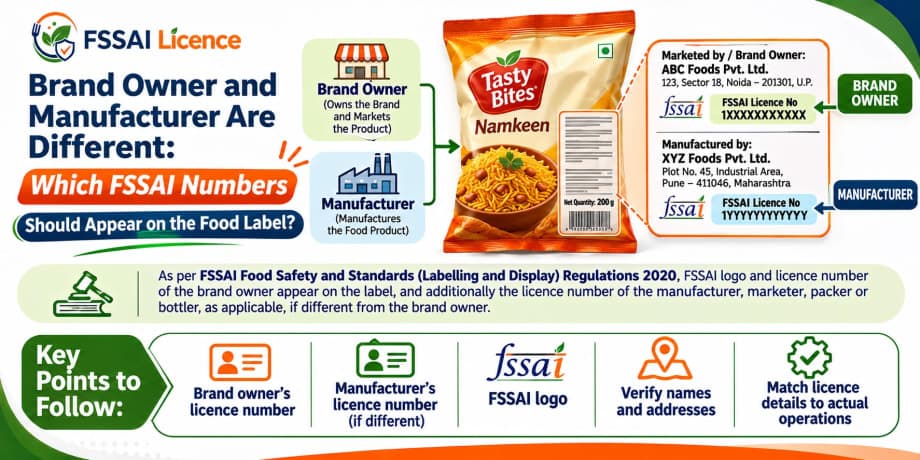
When a brand owner and manufacturer are different food businesses, a packaged food label generally needs the FSSAI logo and the brand owner’s licence number, plus the manufacturer’s licence number. The label must also identify the businesses in their correct roles; a manufacturer’s number alone does not replace the brand owner’s declaration.
For a reader searching for the FSSAI licence number of brand owner and manufacturer on label, the immediate job is to identify the legal businesses and the actual production unit. You may already have the licences needed for the pack. If so, preparing the artwork is a separate exercise from applying for a new food licence.
1. FSSAI licence number of brand owner and manufacturer on label: the rule
Regulation 5(6) and 5(7) of the Food Safety and Standards (Labelling and Display) Regulations, 2020 deal respectively with business identity and the FSSAI logo and licence number. Read them together: the customer needs to know whose brand is on the product and which other relevant business performed the operation.
1.1 How to read the two declarations
The logo and brand owner’s licence number belong together on the label. Where the brand owner is not the manufacturer, marketer, packer or bottler, the number of the relevant other operator must also be displayed, as applicable. For an outsourced product made by a separate manufacturer, this means showing the manufacturer’s number as well.
The business-name declaration is a separate part of the job. The regulations require the brand owner’s name and complete address, and make provision for identifying the manufacturer, packer or bottler where different. Use descriptions that match the operation, such as “Manufactured by” and “Marketed by”, rather than leaving the reader to guess which number belongs to whom.
1.2 Role-by-role decision table
Arrangement | Number decision | Artwork decision |
|---|---|---|
One business owns the brand and manufactures the food | Use the number belonging to that business for the combined role. | Identify the business accurately; a second number is not created merely to repeat the same role. |
Brand owner and manufacturer are separate | Show the brand owner’s number with the logo and the manufacturer’s number. | Identify the brand owner and the manufacturer, including the applicable name and address details. |
A different business packs or bottles the product | Consider the applicable additional operator’s number under Regulation 5(7). | Identify the actual packing or bottling role and its location as required. |
Imported food | Apply the importer-specific logo and licence-number provisions as well as the relevant identity rules. | Review importer and origin declarations for the product; an overseas factory is not treated as an Indian licensee merely because it appears on the pack. |
A separate marketer, a repacker or a relabeller can make the arrangement more complex than a simple two-party contract. Do not assume that listing any two numbers automatically resolves every role. Map each operation first, then apply the relevant declaration to that arrangement.
1.3 A hypothetical private-label pack
Suppose Grain House owns a breakfast cereal brand and Mill Works makes and packs it at Mill Works’ licensed unit. Grain House’s name and address can appear with an appropriate brand-owner or marketing description; Mill Works’ name and manufacturing address identify the factory. The FSSAI logo accompanies Grain House’s number, and Mill Works’ number is also shown.
The example illustrates the structure, not approved artwork. The final wording must reflect the real businesses, addresses and operations. If Grain House later appoints another factory, the old manufacturer’s details do not become correct for that new factory simply because the recipe and brand stay the same.
2. Eligibility and pre-filing checks
A food licence or registration attaches to a food business and its authorised activities; it is not a transferable number that one party can lend to another. Before deciding whether an application is needed, identify the entity behind the brand, the entity making the food and any separate operator packing or handling it.
Identify the legal food business operator for each role, rather than relying only on a trade name printed on a contract.
Identify the actual premises and activity for the batch, including whether manufacturing and packing are done at the same unit.
Check whether each operator has the applicable licence or registration for its own operation and whether its authorised activities cover the work undertaken.
For an existing number, look at its current status and the particulars associated with the relevant business and premises.
If an operation or premises is not appropriately covered, establish the applicable application or modification route before relying on that number for the proposed activity.
2.1 Choose the correct route
Basic registration, State licence and Central licence are different routes. The applicable route depends on the operator’s activities and the criteria governing that business; a brand’s size alone does not decide the manufacturer’s route. A restaurant selling a packaged product should assess its own food business activities separately from those of an external manufacturer.
A relabeller or repacker should likewise identify what it actually does before assuming that a manufacturer’s authorisation covers it. The name used commercially for an arrangement does not settle its regulatory classification. The role and activity recorded for the business matter when determining the applicable food licence.
3. Documents and information to prepare
There are two different sets of material: evidence for the label decision and documents for a licence application. The first is a practical working file; it is not a claim that FSSAI requires a separate label application. The second depends on the application type and activity shown in FoSCoS, the Food Safety Compliance System.
3.1 Evidence for the packaging decision
Licence or registration particulars for each relevant operator: use the current certificate details to establish the number, operator identity, premises and recorded activity. Keep a readable electronic copy or a reliable record of the current particulars for the artwork file.
Manufacturing and packing arrangement: a written agreement, purchase order or operating description helps establish who makes, packs and supplies the product. Its purpose is to allocate roles; it does not replace a licence.
Production-site details: retain the site name and complete address used for the actual operation, together with the contact responsible for approving it. This gives the artwork team a specific unit to identify.
Product specification and full label draft: use the specification to connect the identity panel to the correct product and pack. An editable artwork file and a readable proof help the parties compare the print layout against the approved text.
Artwork approval record: keep a dated record of the approved version and the people who approved the commercial and manufacturing details. This is a practical control, not a substitute for legal compliance.
3.2 If a new food licence application is needed
Prepare the applicant’s identity, business and premises information for the route and activity selected on FoSCoS. Supporting material can vary with the kind of business and application. Use the checklist generated for the relevant application on the official portal rather than assuming that every manufacturer, trader and restaurant has the same document list.
Make scans readable and consistent with the information entered in the application. The portal’s instructions govern the accepted uploads and fields for that filing. An artwork proof can be valuable to your internal project even where it is not a prescribed attachment for the licence application.
4. Step-by-step: from role mapping to print release
For third-party manufacturing, assign one person to coordinate the brand and factory teams. The sequence below separates work needed for every label from the conditional step of applying for a food licence.
4.1 Preparation
Map the product’s route from manufacture to packing and sale.
Record the business responsible for each operation and the unit that will produce the first batch.
Decide which name, address, role description and number belong to each required declaration.
Prepare a draft that identifies the operators without implying that one business performed another’s work.
Ask the brand owner and the production operator to review the relevant portions of the draft.
Resolve any disagreement about the actual role or site before artwork is locked.
4.2 Submission, if a licence is needed
Open the official FoSCoS portal and select the application route for the business and activity. FoSCoS is the filing channel for FSSAI registration and licensing; preparing packaging text is not itself the same filing.
Complete the applicable application. Form A is used for registration and Form B for a licence; follow the portal’s fields and activity-specific instructions for the case.
Upload the applicable supporting material, pay the government amount displayed for the application and submit it. Retain the acknowledgement and application reference for tracking.
Respond through the applicable portal workflow if the authority requests clarification or further information. Track the application until its status is resolved; submitting it is not the same as holding the resulting authorisation.
4.3 Post-submission and artwork release
When the necessary authorisation is available, use its particulars in the controlled artwork. Complete a final review of the full label before ordering packaging, including the identity panel and other declarations relevant to the food. The business should not treat this internal review as an FSSAI approval of the artwork.
Where all parties already have the appropriate current authorisations, the application steps may not be needed. The remaining work is still substantive: assign responsibility, prepare the proof and obtain a clear release decision before the packaging supplier prints it.
5. Government fees, service costs and timing
There is no useful single price for every outsourced-food arrangement. First establish whether the project involves a registration or licence application, a change to an existing authorisation, professional assistance, packaging work, or several of these.
5.1 Budget by cost type
Government application charge: if a filing is required, the amount depends on the applicable route and details selected. Use the amount shown for that application in FoSCoS rather than treating a manufacturer’s fee as the brand owner’s fee.
Professional service charge: an adviser’s charge is separate from the government amount. Ask for a written scope covering preparation, filing, responses and any label review you want included.
Artwork and packaging costs: design changes, proofs, printing plates, minimum print runs and unused stock are commercial costs. They can be significant even when no new licence application is necessary.
Correction and rework costs: allow for changes before production, particularly where several suppliers must approve the same pack. A cheap large print run can become expensive if it cannot be used after a site change.
Do not budget a compulsory, separate government “label approval fee” merely because two numbers appear on a pack. The need for a particular filing depends on the actual regulatory route; the label-design work described here is not presented as a universal approval application.
5.2 Plan around milestones
For an already licensed arrangement, the schedule is mainly a commercial one: collecting accurate particulars, approving artwork, obtaining a printer’s proof and receiving packaging. Each party’s response time and the printer’s production schedule affect the launch date.
If a licence application is needed, add time for portal submission, authority scrutiny and any clarification or inspection applicable to that case. The duration varies with the application and its progress; a packaging deadline should not be treated as a guarantee of grant. Build the printing decision around an available authorisation, not an assumed approval date.
6. Common mistakes and how to correct them
Most identity-panel problems arise when an artwork file is copied forward without rechecking the commercial arrangement. The following controls deal with distinct failure points and help avoid scrapping printed stock.
Showing only the factory’s number: the factory may have supplied the original label template, but that does not remove the separate brand-owner declaration. Correct the panel by assigning the brand owner’s number to the logo declaration and adding the applicable manufacturer details.
Giving the right number to the wrong role: a label can contain valid-looking numbers and still misidentify the businesses. Match each number and description to its holder, then have the relevant operator approve the corrected proof.
Using “marketed by” as a substitute for manufacturing identity: commercial marketing and physical production are different functions. Where the manufacturer must be identified, add the required manufacturer information rather than assuming the marketer’s details cover it.
Reusing a proof from another unit: the same supplier may operate more than one facility. Replace unit-specific information with details for the facility making the batch, then issue a new controlled artwork version.
Letting a design change obscure the number: a number hidden by a fold, seal, overprint or dark background is difficult to read. Review the printer’s actual proof and the finished pack, not only a flat screen image.
Treating an application reference as a licence number: a tracking reference identifies a filing; it is not the number to present as the granted authorisation. Keep the artwork on hold until the correct particulars are available.
A factory switch can strand pre-printed packs even when the brand and ingredients remain unchanged. Before committing to a large order, agree who bears the cost of obsolete material and how replacement packaging will be released.
7. Post-registration and ongoing label controls
A compliant proof is a starting point, not a permanent approval for every future batch. The brand and manufacturer need a way to connect each production run with the artwork and unit actually used.
7.1 Release and traceability
Keep a master copy of the approved artwork and give the printer and factory a version identifier. At production, the responsible team can compare the pack against that master before releasing the batch. Retain a record linking the version, production unit and batch so that a complaint or withdrawal can be investigated efficiently.
Agree who may authorise an artwork change. The brand may control design while the factory supplies site particulars; neither should silently alter the other’s approved information. A shared sign-off record also helps a replacement designer understand which text is fixed and which text is batch-specific.
7.2 Changes after launch
A change of legal entity, premises, contract manufacturer, packing arrangement or licence particulars can affect the identity panel. Route such changes through a documented review before the new arrangement starts. If existing stock cannot accurately describe the new operation, decide how it will be handled before sending it to the production line.
Monitor the status and particulars of the authorisations on which the label relies, and update the internal record when they change. The relevant operator remains responsible for maintaining its own authorisation; the brand’s artwork file should not be the only place where this information is held.
7.3 Restaurants, imports and other declarations
A restaurant using an outside producer for a retail pack should address the pack’s identity declarations as well as the requirements applicable to its food-service operation. A menu or premises display serves a different purpose from the label on a packaged product; one should not be assumed to replace the other. Menu-display obligations depend on the applicable rules and circumstances.
Imported products need a separate review of importer, origin and other applicable declarations. The Indian importer’s particulars should not be confused with an overseas producer’s identity. Special product categories and particular pack formats may also have additional rules or exemptions.
Finally, numbers are only one part of FSSAI food label compliance. Depending on the product, the complete artwork may need declarations concerning the food name, ingredients, nutrition, net quantity, batch and date marking. Review those requirements and applicable Legal Metrology provisions alongside the identity panel, rather than assuming that two correct numbers make the whole pack compliant.
8. Your next three actions
If the brand and factory already have appropriate authorisations, name an artwork owner and request a joint review of the identity panel for the actual production unit.
If an operator needs an application or change, identify that operator and its activity first; keep the proposed print run separate from the filing decision.
Before committing to packaging, set a release date, obtain the parties’ written sign-off and decide how much site-specific stock the business can afford to hold.
For a straightforward, fully documented arrangement, an operator may choose to manage the filing and artwork coordination itself. A multi-party arrangement, a disputed role or an application needing specialist support may justify engaging assistance. Begin the process online via the official government portal, or engage FSSAI Licence for end-to-end assistance