Licenses
✍️ Akansha • 27 November 2026 • 14 min read
FSSAI Importer Licence and IEC Details Do Not Match? What Should an Importer Check?
Reviewed by: Team FSSAI Licence
Last updated on:
Get Free Consultation
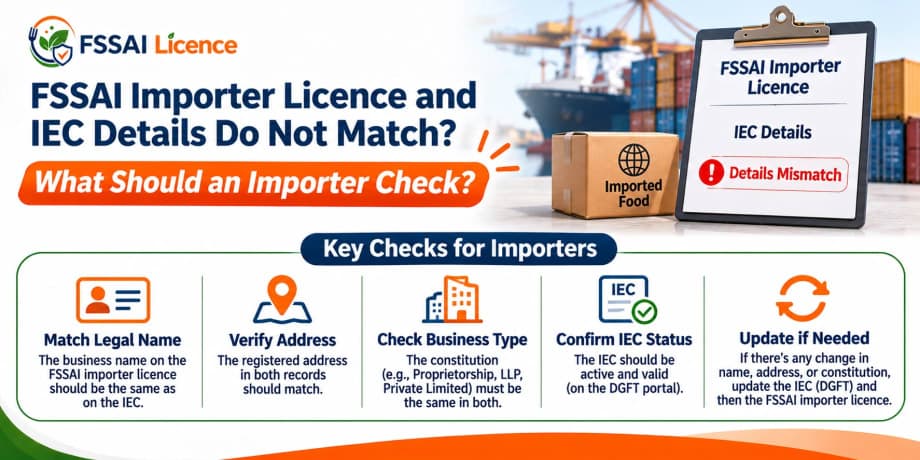
An FSSAI importer licence IEC mismatch calls for a check of the importing entity, its PAN, the licence details and the IEC record—not an automatic change to both records. Identify which detail is wrong, correct it with the authority that maintains it, and follow up on any separate portal validation or consignment objection.
Start by establishing where the problem appeared: a food licence application on FoSCoS, the Directorate General of Foreign Trade’s IEC record, or an import-clearance transaction. Those are different stages, and an error at one stage does not tell you by itself which record needs modification.
1. FSSAI importer licence IEC mismatch: eligibility and pre-filing checks
1.1 Identify the importer
The business importing food commercially must identify the legal person responsible for the transaction. It may be an individual proprietor, a company, a partnership or another entity; a trade name alone does not establish who that person is.
For food importers, the relevant food licence is a Central FSSAI licence for the importer activity. The IEC is issued through the Directorate General of Foreign Trade, or DGFT. FSSAI licensing and the IEC serve different purposes, so holding one does not replace the other.
Make the eligibility decision around the business that will act as importer, rather than the restaurant, manufacturer, foreign supplier or logistics agent involved elsewhere in the supply chain. A business that buys food domestically from an importer should assess its own food-business activities rather than assume it is the importer for that transaction.
1.2 Check the scope of the food licence
Identify the legal entity that will import the food and the person authorised to act for it.
Establish whether that entity holds an applicable Central licence covering its importer activity, or needs to apply for one.
Identify the IEC intended for that same importing entity.
Identify the address and business activity to which the FSSAI application or licence relates.
Check whether the issue concerns an existing licence, a new application or a particular consignment.
An importer may also carry on other food-business activities. Assess those activities and premises on their own facts; an importer endorsement should not be treated as a blanket answer for every warehouse, manufacturing operation or outlet.
Special-purpose imports can raise different questions from ordinary commercial imports. If the shipment is for research, exhibition or another exceptional purpose, establish the applicable route before treating the standard commercial-import workflow as conclusive.
2. Documents to assemble and what each one establishes
The following is a practical working file for an FSSAI importer licence correction or application. It is not a claim that every item must be uploaded in every case: the applicable portal fields, the transaction and the authority’s requests determine the filing evidence.
2.1 Identity and authority records
IEC record: Keep the current DGFT record or certificate available to establish the code and the particulars recorded against it. Use a readable copy or the details shown in the account, as appropriate to the task.
FSSAI licence or application: Keep the current licence, or the application acknowledgement and entered details if the licence has not yet been issued. This shows the relevant licence number or application reference and the particulars being examined.
PAN evidence: Keep the PAN details for the legal person concerned. The Income Tax Department’s e-filing portal is a source for tax-account information; an individual’s PAN should not be assumed to be the PAN of a separate company.
Constitution or legal-name evidence: Depending on the entity, a certificate of incorporation, partnership deed or other relevant record can establish its legal identity and support a documented name change.
Authority to act: Where a representative files or communicates for the business, retain appropriate authorisation identifying that person and the entity represented.
For a name change, keep evidence connecting the earlier and current names, rather than only a document showing the current name. That connection helps the reviewer understand whether the history concerns one continuing entity or two different entities.
2.2 Address, licence and transaction records
Premises evidence: Retain a document establishing the relevant premises address and the business’s right to use it, where applicable. Its purpose is to support the address concerned, not to prove that every business address must be identical.
Error evidence: Save the exact error text, date, application or transaction reference, and a screenshot if available. Mask information that is unnecessary for the recipient of a support request.
Consignment records: If the issue arose during clearance, keep the relevant commercial and customs records, including the importer details entered for that shipment and the objection or query received.
Previous correspondence: Retain acknowledgements, notices and responses concerning any earlier correction. They help establish which request was made and whether it was completed.
Prepare readable electronic copies in the formats and sizes accepted by the relevant portal when filing. The exact upload list can differ between a fresh licence application, a modification request and a response to a clearance query; use the requirements displayed for the chosen transaction.
3. How to correct or escalate the discrepancy
Use this sequence for a self-filed case. The aim is to avoid submitting a change to an accurate record merely to make two fields look alike.
3.1 Prepare the case
Write down the exact field in dispute, the value shown in each record and the value you believe is correct.
Identify the legal person and the relevant date for each value.
Decide which authority maintains the inaccurate record.
DGFT maintains the IEC; FSSAI licensing is handled through the Food Safety Compliance System, known as FoSCoS.
Determine whether the issue is a record correction, a request to modify an existing licence, a new application issue, or a technical or clearance query.
A validation message alone may not identify which of these applies.
Submit the appropriate request through the relevant official account or respond through the channel specified in the authority’s query.
Retain the submitted information and acknowledgement.
Track the request, respond to any formal query and review the resulting record.
If a separate transaction still fails, raise that remaining issue with the support or authority responsible for that transaction.
3.2 Submit through the right channel
For a DGFT IEC address correction or another IEC detail that is genuinely inaccurate, use the IEC-related service available in the business’s DGFT account. Select the applicable modification function and follow the instructions shown for the field and entity concerned. A submitted request and an updated IEC record are different milestones.
For an incorrect detail on an existing food licence, use the applicable licence-modification route in FoSCoS. If the case concerns a new application instead, work within that application or respond to the licensing authority’s query as directed. Form B is the application form associated with FSSAI licensing; the screen and information needed depend on the transaction selected.
Do not assume that a completed change on one portal automatically edits a record held by the other authority. After the relevant change is approved, inspect the record that needed correction and then return to the transaction that was failing.
For a FoSCoS IEC validation error where the underlying records appear accurate, preserve the error details and use the portal’s support channel. Describe the action attempted and the application reference. Avoid sending passwords or unnecessary personal information with a support request.
3.3 Track the outcome
Keep a small case log: submission date, reference number, current status, any query received, response date and final outcome. One person should own the log even if an accountant, customs representative or service provider is helping.
Where a consignment has already attracted an objection, follow the instructions in that objection or the relevant clearance channel. A licence modification request is not itself a response to a customs or food-clearance query unless the receiving authority accepts it as such.
Before paying for a filing, ask the person handling it to state the field to be changed, the portal on which it will be changed and the evidence supporting the new value. That short instruction can prevent an unnecessary second application.
4. Government charges and professional fees
The cost depends on the transaction actually needed. A new Central licence, a licence modification, an IEC-related request and assistance with a clearance objection are separate matters; do not treat a quote for one as the government fee for all of them.
Cost item | What to look for | Who receives it |
|---|---|---|
FSSAI portal charge | The amount displayed for the selected application or modification, where payable | Government portal or authorised collection channel |
DGFT portal charge | Any charge displayed for the selected IEC transaction | Government portal or authorised collection channel |
Professional assistance | Scope, price, taxes and whether responses to queries are included | The service provider |
Related transaction costs | Possible document preparation, logistics or consignment-related charges, if applicable | The relevant provider or authority |
A professional fee is optional expenditure, not a substitute for a government payment. Ask for an itemised written quote and the portal payment receipt. Also establish who will control the account, receive notices and file a response if the authority raises a query.
The current charge and available transaction should be read from the relevant official portal before payment. A single fixed figure for “food licence fees” would be misleading here because the necessary action has not yet been identified.
5. Timeline: milestones and sources of delay
Preparation ends when the disputed field, correct value and supporting evidence are identified.
Submission produces a reference or acknowledgement; it does not necessarily mean approval.
Review may include a query requiring a response from the applicant.
Completion should be assessed against the updated record or formal outcome.
A separate validation or clearance issue may remain after the record is changed.
Allow for the possibility that an IEC update and an FSSAI licence IEC details update must be handled in sequence. If one request depends on an earlier correction, the overall elapsed time includes both stages as well as the applicant’s response time. Technical issues or a pending consignment query can add a further stage.
There is no reliable case-specific completion date in the information available for this guide. The nature of the correction, completeness of the submission, authority queries and the relevant portal workflow all affect the outcome. An acknowledgement date should not be presented to a buyer or logistics team as a promised clearance date.
For a live shipment, tell the commercial team which milestone is outstanding and what evidence would establish completion. That makes it easier to plan storage, transport and customer communication without assuming that a licence correction alone releases the food.
6. Common mismatch causes and how to resolve them
6.1 Name and entity identity
An FSSAI importer licence name mismatch may arise because one record uses a legal name while another displays a trade name. Compare the identity behind each name before changing either field. A trade name can help identify a business commercially, but it should not obscure the legal person responsible for importing.
A documented legal-name change is a different case from an unrelated entity using a similar name. If the record is outdated, the correction should follow the authority’s applicable process. If the IEC belongs to one company and the licence belongs to another, changing a spelling will not resolve the underlying identity problem.
A representative may prepare documents or file on the importer’s behalf. Representation does not, by itself, make that representative the importing business. Record the capacity in which each party acts so that the importer’s identity is not confused with the agent’s.
6.2 PAN and IEC details
An FSSAI importer PAN mismatch deserves an entity-level check. First establish whether the PAN entered belongs to the person or entity shown as importer. A director, partner or employee may have a personal PAN, but that does not make it interchangeable with the PAN of a separate legal entity.
Also compare the IEC number entered with the current DGFT record. A transposed character or an old reference can produce a different investigation from a genuine disagreement about the importer’s identity. Keep the full error and transaction context rather than repeatedly submitting changed values without a basis.
If an intermediary supplied the IEC details, ask them to identify whose IEC they are and why it was used. The appropriate correction depends on the true transaction and the records; the goal is not to select whichever number makes a screen advance.
6.3 Addresses
An FSSAI licence and IEC address mismatch does not automatically establish a violation. An IEC may show an address for one business function, while an FSSAI licence identifies a particular licensed premises or activity. Read the field labels and identify what each address is intended to represent.
Do not replace a valid licensed-premises address with a registered-office address solely to make the two records visually identical. If a field is inaccurate, correct that field; if both addresses are accurate but the portal rejects the transaction, explain their different roles in the support request.
Hypothetical: A company’s IEC identifies its registered office, while its food licence identifies a different premises used for the licensed activity. The two addresses may have different functions. The company should investigate the field being validated and the actual status of each address before requesting a change.
Conversely, a genuine FSSAI importer licence address change is not merely a formatting exercise. If the licensed business has moved or the recorded premises is wrong, the relevant licensing record may need attention. Treat the actual premises and business activity as the facts to establish, not the address printed most often on commercial paperwork.
6.4 Portal and clearance errors
“FSSAI IEC verification failed” describes an outcome, not necessarily its cause. It may require investigation of entered values, record status or a technical problem. An exact screenshot and reference make a more useful support request than a statement that “the licence is not linked.”
Similarly, a FICS importer validation error should be separated from a final decision on the food itself. FICS is FSSAI’s Food Import Clearance System; the relevant query or status should be read in the context of the consignment. An identity objection and a product or labelling objection call for different responses.
If an importer receives an FSSAI food import clearance rejection or objection, retain the written grounds and respond to the authority through the specified route. Do not infer that every rejected shipment can be fixed by changing an IEC or licence. The decision may concern an entirely different clearance issue.
7. What to maintain after the correction
Once the record or validation issue is resolved, retain the final outcome with the licence and IEC records used by the business. Give the current details to the team preparing import transactions, while keeping earlier records and correspondence available to explain the change history.
For each consignment, maintain a traceable file connecting the importer, supplier, product and shipment records. This helps the business respond to an authority’s query and identify affected stock if a safety issue arises. Keep responsibility for the file clear when a customs representative or logistics provider holds some of the documents.
Food import clearance remains a separate compliance stage. Imported food must meet applicable Indian food-safety requirements, including relevant product and labelling rules. Review the requirements applicable to the actual product and packaging; matching importer identifiers does not establish product compliance.
Maintain the food licence and its details in line with the rules and official requirements applicable to the business. When the entity’s legal identity, premises or activities change, assess the effect on the records rather than waiting for the next consignment to expose a discrepancy.
There is no universal “link successful” message established by the material in this guide. The useful evidence is the completed transaction or formal outcome for the particular portal and shipment, together with the records on which it relied.
8. Choose your next action
Assign the case: Name the importing entity and the person who will own the correction or query.
Choose the route: If an official record is wrong, pursue the appropriate correction; if the records are accurate but validation fails, prepare a focused support request; if a consignment is objected to, respond to its stated grounds.
Set the hand-off: File it yourself if the issue and evidence are straightforward. Consider assistance when entity history, multiple records or a live clearance objection makes coordination difficult; agree the scope and account access first.
Begin the process online via the official government portal, or engage FSSAI Licence for end-to-end assistance