Licenses
✍️ Akansha • 27 November 2026 • 13 min read
Your Old FSSAI Licence Still Shows an Expiry Date: What Should You Check Under the New Rules?
Reviewed by: Team FSSAI Licence
Last updated on:
Get Free Consultation
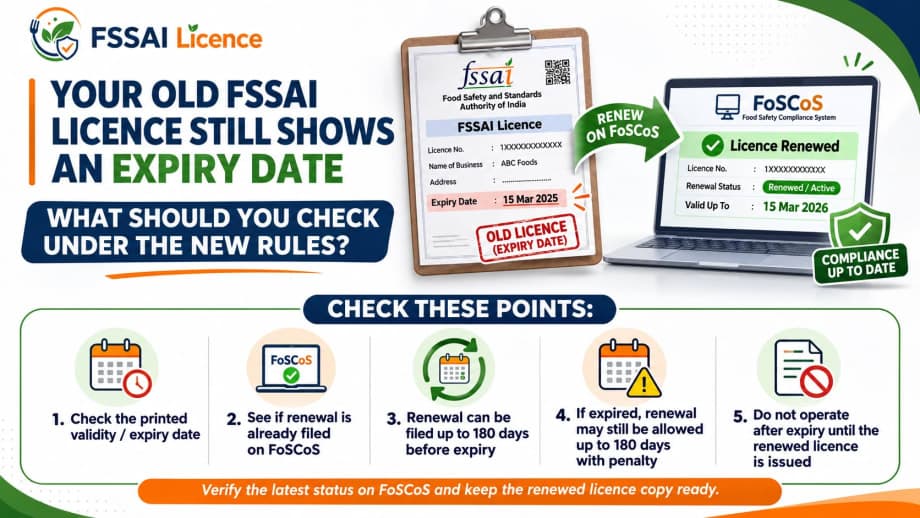
An expiry date on an old FSSAI certificate does not, by itself, tell you whether a 2026 transition has changed the status of your particular food licence. Check the current record on FoSCoS and the applicable FSSAI instructions before treating it as either expired or automatically perpetual.
If you are searching for “FSSAI old licence expiry date new rules 2026”, the immediate task is to identify the holder, the record and its current status. Reports about perpetual validity do not, on their own, establish whether your record needs a payment, an application or no transition filing.
This guide separates what you can prepare and check from matters that depend on the official instructions for your case. It also helps you compare the government charge with any optional professional fee before authorising a filing.
1. FSSAI old licence expiry date: what do the new rules in 2026 mean?
1.1 Read the certificate and the live record separately
Your certificate is an official document issued for a particular registration or licence. Its printed dates matter, but an older copy may not show a later application, a subsequent decision or another change recorded against the same business.
The FoSCoS record and any later official communication provide additional information. A displayed status should be read together with the applicable rule and the record history: a certificate download, a payment receipt and a pending application are different pieces of evidence.
There is not enough verified official material in the information available for this guide to say that every existing licence was automatically converted, or that every dated certificate must be renewed once. Nor can the April 2026 transition be applied to an individual record solely from the date printed on a PDF.
1.2 Perpetual validity and annual payment are different questions
“Perpetual” or “lifetime” validity is often used to describe a licence without a scheduled end date. It should not be read as a promise that a licence can never be suspended or cancelled, or as proof that every other compliance obligation has disappeared.
Equally, a government payment and an application to extend or change a record are not necessarily the same transaction. Before acting on a claim that FSSAI licence renewal has been abolished, establish which rule applies to the type and history of your record. Do not select a payment merely because its name resembles the advice you have received elsewhere.
2. Eligibility and pre-filing checks
2.1 Identify the holder and the record
Start with the food business operator named on the certificate. A person who manages an outlet or holds the FoSCoS login may not be the legal holder. The record you are checking must correspond to the operator and the business activity for which you need the status.
Also distinguish a basic registration from a state or central licence. They are different types of authorisation, and the appropriate category depends on the applicable rules and the business’s facts. The certificate type should not be inferred just from what someone calls it in conversation.
If your scale or activities have changed since the certificate was issued, assess whether the present authorisation still matches the business. Turnover can be relevant to classification, but the applicable limits and other category conditions must come from current official material; an old threshold or a competitor’s summary is not a reliable substitute.
2.2 Choose the question before choosing a filing
Situation | Question to resolve |
|---|---|
Old certificate has a future or past printed expiry date | What status and transition instructions apply to this record? |
Record shows a pending application | What has been submitted, and is a decision or response outstanding? |
Business details have changed | Does the change require a modification or another authorised route? |
Record shows suspension or cancellation | What does the official order say, and what remedy or application is available? |
No matching record can be found | Is the number, holder or account being searched correct? |
These are starting points, not a guarantee that FoSCoS will offer a particular transaction. Section 31 of the Food Safety and Standards Act, 2006 addresses licensing and registration of food businesses; the relevant regulations and official instructions determine how that framework applies to a particular operator.
3. Documents and information to prepare
3.1 For a status enquiry
The first group is a working file for identifying the record. It is not a claim that every item must be uploaded to FoSCoS.
Existing certificate: Keep the latest available PDF or a legible scan. It identifies the holder, authorisation type and printed dates.
Licence or registration number: Copy it exactly from the certificate so that the enquiry relates to the intended record.
Holder and business particulars: Note the legal name, premises address and activity shown on the certificate. These help distinguish the record from another business entry.
Earlier application and payment records: Retain acknowledgements and receipts in their original electronic form where available. They help establish what was filed or paid and when.
Official notices or orders: Keep complete copies, including reference numbers and dates. These may explain a status that an old certificate does not show.
Account access details: Identify the authorised user and accessible contact email or mobile number. Do not circulate passwords as part of a document bundle.
3.2 For a filing, if FoSCoS requests it
A filing may require current business particulars, supporting evidence for a requested change, declarations or other material relevant to the selected transaction. The exact list and acceptable file specifications depend on the application and the instructions shown for it. Prepare readable electronic copies, but do not assume that the entire original licensing file must be uploaded again.
If a representative will handle the matter, keep a written record of the representative’s authority and the agreed scope of work. That is a practical control over access and responsibility; it should not be confused with a claim that the same authorisation document is mandatory for every FoSCoS transaction.
Where the only issue is that an expiry date has not changed on an old PDF, preserve that PDF alongside any newer certificate or communication. The two versions can help identify whether the concern is an outdated copy, a difference in the record history or a question requiring an official response.
4. How to check the record and submit the appropriate request
4.1 Prepare
Set aside enough time to inspect the record before starting a paid application. A status enquiry and a filing have different purposes: the first establishes what is recorded; the second asks the authority to take an action.
4.2 Check and submit
Open FoSCoS: Use FSSAI’s Food Safety Compliance System, the official portal for food business licensing and registration. Access the relevant account or available record-search facility.
Locate the record: Use the number and identifying particulars from your working file. Read the displayed record and any available application history rather than relying on the date in an old certificate alone.
Identify the official instruction: Look for the applicable FSSAI regulation, notice or portal guidance for the record’s status and the action you are considering. Where the record or instruction does not resolve the transition question, raise an enquiry through the official support or licensing channel before selecting a paid route.
Select an applicable transaction: If an official instruction calls for a filing or payment and the relevant option is available for the record, follow the portal prompts. Review the transaction type, particulars and calculated amount before submission.
Complete the submission: Provide the information and supporting files requested for that transaction, make the displayed payment if applicable, and save the acknowledgement and transaction reference.
Follow the record to an outcome: Monitor the application for official communications. When a decision or updated certificate is available, save it separately from the receipt and earlier certificate.
4.3 Keep a record after submission
Record who submitted the transaction, what action was selected and which contact details will receive communications. If an adviser files on your behalf, ask for the acknowledgement and a copy of the submitted particulars rather than retaining only an invoice from the adviser.
For a certificate download, use the document made available for the relevant record or application on FoSCoS. Do not assume that a newly downloaded file must have a particular validity wording: compare what the issued document says with the applicable official instruction.
FSSAI uses prescribed application forms for licensing and registration, but a form number should be taken from the applicable current procedure for the transaction. An old form reference may not describe the screen or submission required for your particular transition issue.
5. Government fees and professional charges
5.1 Build the total before paying
The amount payable depends on the transaction and the applicable official fee schedule. The supplied evidence does not establish a current fee table for the 2026 transition, so a fixed charge for your record cannot responsibly be stated here.
Cost component | What to establish |
|---|---|
Government charge | The amount applicable to the selected transaction and authorisation category, shown or supported by the current official schedule. |
Additional government amount, if applicable | Whether the official rule or portal calculation applies any additional amount to the particular case. |
Professional service fee, if engaged | The separate amount charged for review, preparation, submission or follow-up. |
Other agreed service costs, if any | Whether taxes or separately priced work are included in the professional quote. |
Use this calculation: total expected outlay equals the applicable government amount plus any applicable additional government amount, plus the professional fee and any separately agreed charges. A professional quote should identify those components; it is not itself evidence of the government fee.
5.2 What a quote should cover
Ask whether the service includes only a status review or also an application, responses to official queries and delivery of the final document. If the correct route cannot be identified at the outset, ask how the fee changes if the work turns out to be an enquiry rather than a filing.
For help with an applicable renewal route, FSSAI Licence Renewal is a relevant service option. Request a breakdown before authorising work, and keep the government acknowledgement separate from the service provider’s invoice.
6. Timeline: from status check to decision
6.1 Track milestones, not just payment
A straightforward record lookup may give you useful information during the session, but it does not necessarily settle a disputed transition or a previous application. An enquiry that needs an authority’s response has a different timeline from an online lookup.
For a filing, record three milestones: submission, any response to an official query, and the final decision or issued document. A successful payment may occur at submission; it does not establish the date on which a decision will be made.
6.2 Where time can vary
Timing depends on the transaction, the information sought by the authority and whether the record requires additional review. A matter involving an earlier order or an unclear record history can require more investigation than a routine status check.
The supplied official evidence does not establish a verified processing benchmark, renewal window or late-filing deadline for this specific 2026 transition. Do not use a third-party countdown as your filing deadline without the applicable official basis. Where a deadline is stated in an official notice or order addressed to your case, record the exact date and the action required.
7. Common mistakes and how to correct them
Assuming the old PDF is the whole history. An earlier copy may omit a later decision. Compare it with the available record and retain the relevant dated documents.
Choosing a transaction by its label alone. A payment, modification, renewal and fresh application can serve different purposes. If the official basis for the proposed action is unclear, resolve that question before submitting.
Filing against the wrong holder or record. A familiar outlet name may not uniquely identify the legal operator. Correct the identification issue before authorising work on the account.
Treating an expired, suspended or cancelled status as interchangeable. Each describes a different issue. Read the applicable record and order; do not assume that paying a fee automatically restores an authorisation.
Paying twice because a screen appears unchanged. Preserve the first transaction reference and investigate its status before making another payment.
Using an acknowledgement as the final certificate. An acknowledgement proves a submission was recorded; read the subsequent decision to establish the outcome.
If the record appears expired under the old rules, do not assume that a post-expiry route, automatic revival or a fresh application is available in every case. The official record and applicable instructions must determine the next action.
A service provider can be useful when the record history is difficult to reconstruct or an official order needs interpretation. Give the provider the complete history, not only the last page of the old certificate, and ask them to identify the basis for the proposed transaction.
8. Compliance after the status check
Food safety duties do not end when a certificate is located. The operator remains responsible for complying with the Food Safety and Standards Act, applicable regulations and the conditions attached to the authorisation. The exact obligations depend on the business and its activities.
Maintain an internal register showing the authorisation number, holder, premises, type of activity and location of the current certificate. Assign a person to monitor official communications and record changes in the business. This register is a practical management tool, not a substitute for the official record.
Where an official instruction makes a payment, return or other action applicable, assign it an owner and retain evidence of completion. The supplied evidence does not establish a verified 2026 rule on the consequence of annual fee non-payment for every record, so suspension should not be assumed solely from a third-party description.
If the authority issues a notice or order, record its reference, required response and stated deadline. A notice may call for a different response from an ordinary account update; preserve the complete communication with any response submitted.
9. Your next three actions
If you have a dated certificate: identify its holder and number, then inspect the corresponding FoSCoS record and history.
If the status or 2026 transition is unclear: identify the applicable official instruction or raise an official enquiry before paying for a conversion, renewal or migration.
If an action is required: compare the official charge with any professional quote, submit the applicable transaction and keep its acknowledgement until a decision is issued.
Begin the process online via the official government portal, or engage FSSAI Licence for end-to-end assistance